
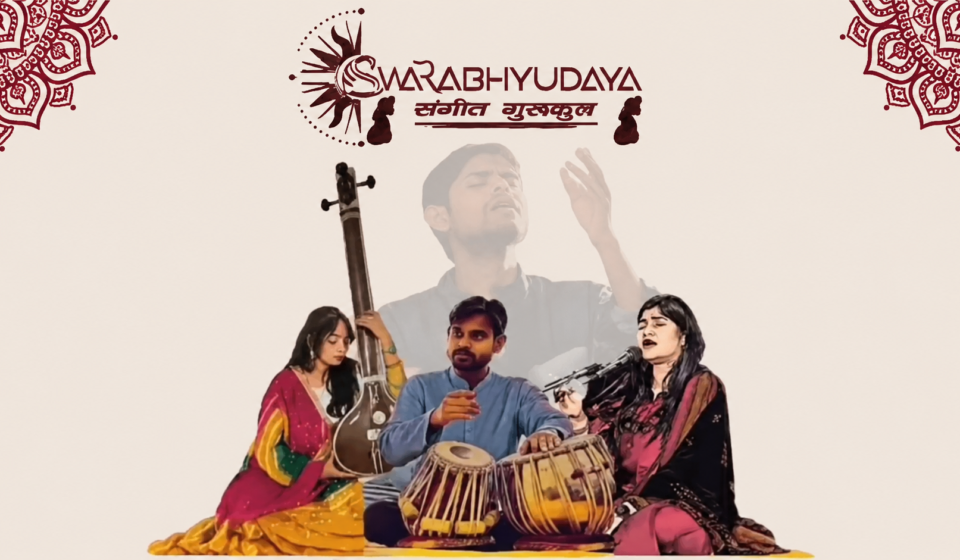
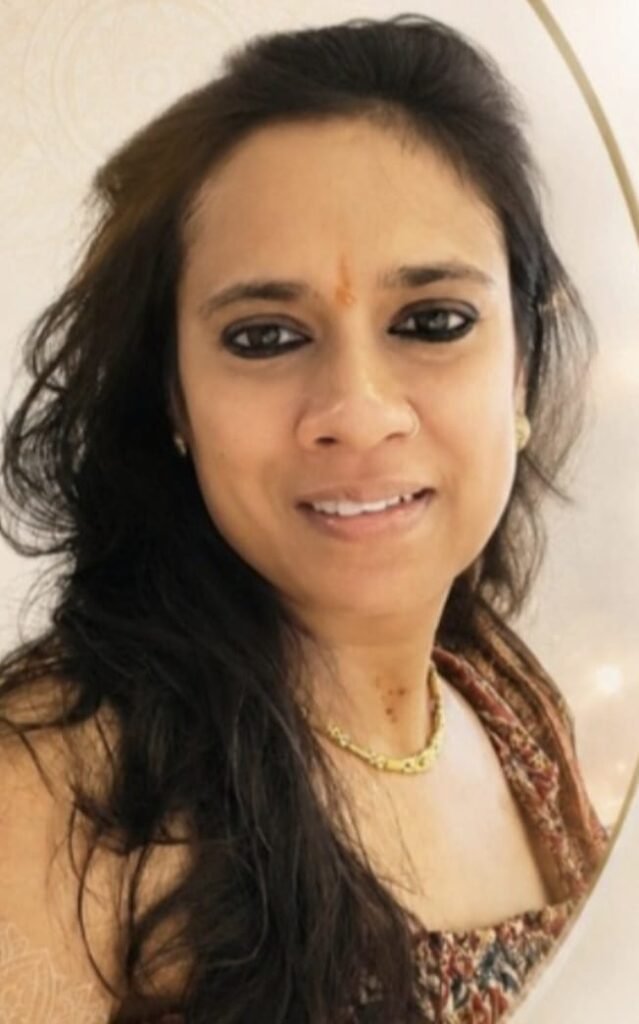
SWARABHYUDAYA …Dipti Kumari
– by Neha M. R. Aggarwal
There are those whom you know, whose talent inhabits them innately, until one day, you realize you have been standing next to something extraordinary all along. Dipti Kumari is that someone I know.
I knew her from Ranchi. I knew her from gatherings. I knew that she had a lovely voice. I knew that, sooner or later, somebody would ask her to sing. And she would ! That was the extent of my understanding.
Dipti sings. It took me years to discover that the sentence was woefully inadequate. It was one of those relatively quiet months of 2018 when she called to invite me to the birth celebration of her twins. It was, of course, anything but quiet once one reached the party. A large gathering, familiar faces, conversations overlapping, children everywhere, the easy social bustle that Ranchi gatherings seemed to acquire.
Dipti and I would continue to bump into each other at such gatherings. And slowly, almost imperceptibly, the acquaintance became friendship.
There was a scholarship programme to be organised at Raj Bhawan when Smt. Droupadi Murmu was the then Governor of Jharkhand. I was heading the programme and we were looking for a choir. Dipti volunteered. “Okay,” I thought. She sings well. I still was oblivious.
That first assumption would become a running joke in my own mind years later. Because once I had heard her sing, gatherings acquired a predictable ritual. “Dipti, kuch sunao.” And Dipti would hum. A line would become a phrase. A phrase would become a melody. The melody would settle into the room.
The rest of us would attempt. Dipti would sing ! There is, I have since discovered, a considerable difference between the two.
The friendship that arrived without ceremony.
Friendships rarely announce their importance while they are being formed. They accumulate. A conversation here. A gathering there. A concern that she expressed and I remember the same till date.
There were a few get – togethers I missed, and Dipti called to check on me. I told her about my recently diagnosed cancer and the chemotherapy sessions.
She did not respond with the kind of sympathy that makes illness feel even larger. She simply came. Within hours, she was at my home – with her children. And they arrived with precisely what my home needed then: noise, movement, laughter, children, exuberance, life. She did not come to discuss my illness. She came to occupy the space around it until, for a while, it mattered less. The memory nourishes me even today.
Because it says something about Dipti that her music also says. She does not merely enter a space. She fills it. With people. With sound. With warmth. With life. Then life rearranged itself.
I moved to Delhi. The physical geography changed, but the friendship pendulumed between scarce phone calls. And during those conversations, I learnt about her pursuing music seriously. I listened with the casual confidence of someone who thought she already knew the story.
Of course she would sing. She always had. What I did not know was that I was listening to a woman beginning to return to herself. Returning to her calling.
Music had entered Dipti’s life long before either of us knew that it would become its central recurring motif. Her family had noticed it when she was barely five. She’d be summoned to humm every time guests showed up. The sort of thing that makes parents experience pride about their success at nurturing their offsprings.
“Bachchi gaati bahut achha hai.”
Except that in Dipti’s case, the child kept singing. Music was already woven into the family fabric. Her grandfather was a Keertaniya in the village. Her father, too, had propensity for music.
And then, at twelve, she began formal training under her first guru, Shri Rajnish Kumar, at a music institute in Patna.
The young Dipti was good. Good enough for the outside world to notice. She was offered two songs in a Bhojpuri film, Piritia Bikaala Naahi. The songs subsequently attracted the attention of T-Series, and a five-album contract was offered.
It sounds, in retrospect, like the beginning of a musical career. It wasn’t. Studies prioritized. Her parents aimed at academic excellence. The music opportunity would require a move to Bombay. And so the voice that might have travelled through recording studios instead travelled through classrooms.
After Class 10, music took a backseat. Not because she had stopped loving it. Because life has a unique way of having the petals bloom.
The engineer.
Dipti went on to Delhi for studies. Followed by Civil Engineering at Cochin University of Science and Technology, Kochi. She graduated as a university rank holder.
The singer became an engineer.
Then came marriage. Then work. JUSCO. Electrosteel. Vedanta. Bokaro. Several professional assignments. Different cities. Different responsibilities. And then children.
Kaavya. Krishav. Kaashvi.
A life that, from the outside, appeared to have moved decisively away from the stage. Except that music had never really left. Some callings are not extinguished. They simply go soft and await their turn.
The pandemic – and the return.
COVID changed the rhythm of the world. For Dipti, it altered something more intimate.
During that period, after years away from formal music, she returned to classical training in Bokaro under Shri Naresh Sinha ji. It was not a nostalgic turn around. It was serious. Structured. Deliberate. She completed her M.A. in Music from Prayag Sangeet Samiti, Allahabad.
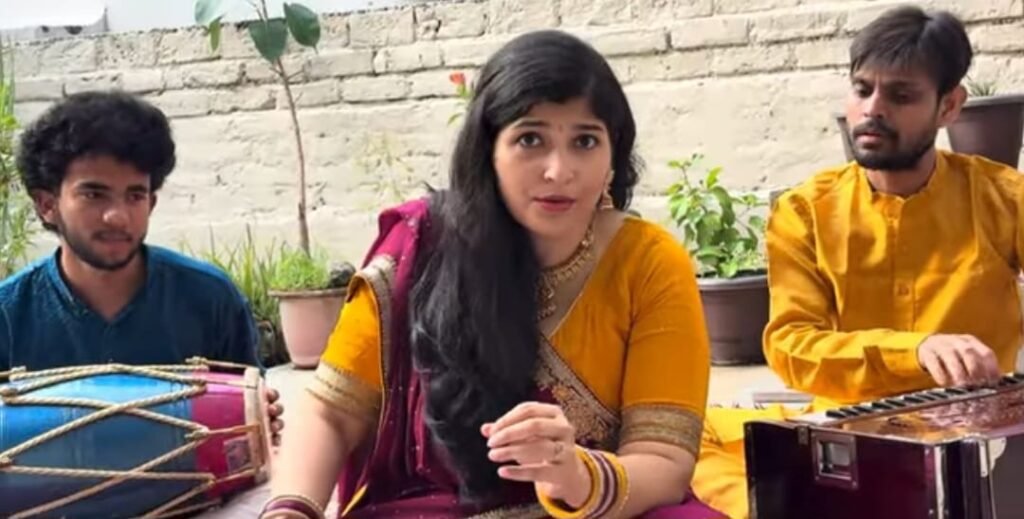
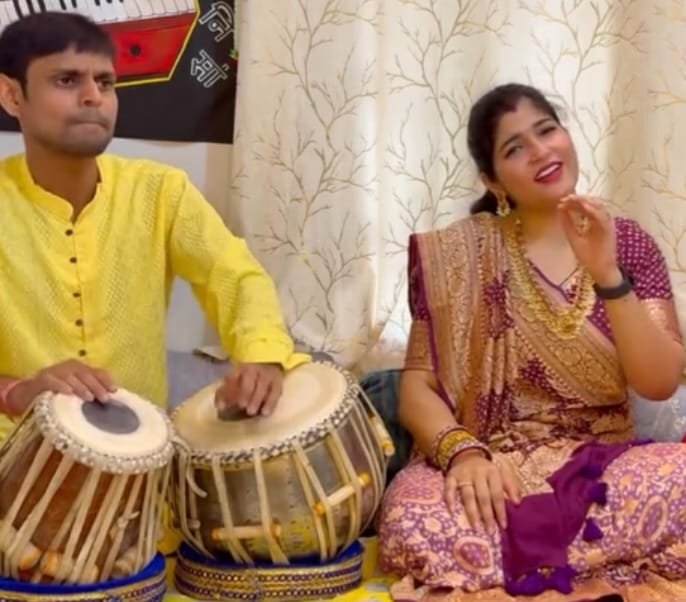
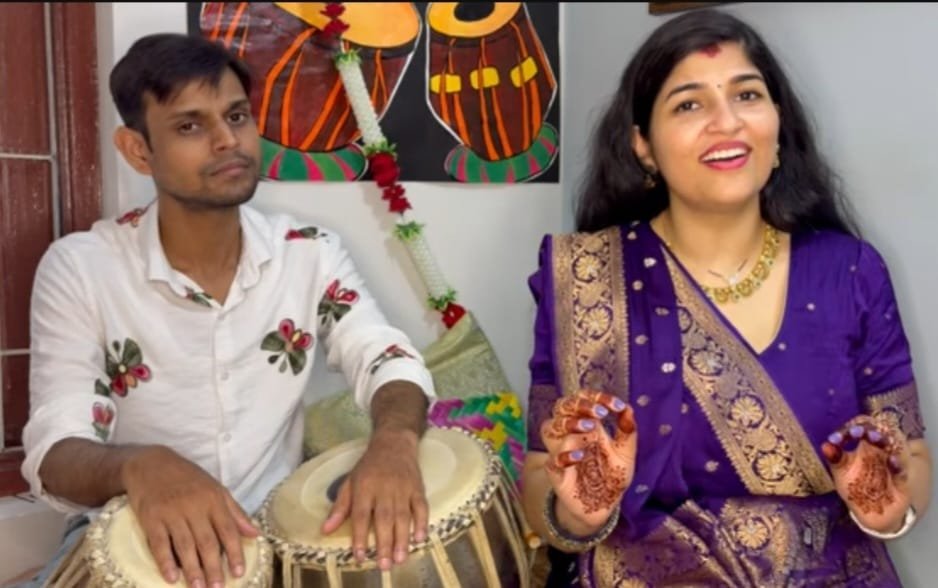
The woman who had once been a promising child singer was now approaching music with the experience of adulthood behind her. That matters. Because technique can be learnt young. But interpretation is often born much later.
A child can learn a raag. A woman who has lived can sometimes feel one differently. Then came Ranchi again.
Life brought her back to Ranchi through Chandan’s (her husband) transfers. July 1 2024, found her joining Ranchi University as guest faculty. This time – besides learning, music was something she taught. She met Dr. Manish Kumar, a colleague who became an important guide in this chapter.
But there was an old restlessness in Dipti. She wanted to create. Not merely participate.
She prompted to herself a very Dipti-like question: What if we built a space where the music could be taught the way we believed it should be?
And so, in association with Dr. Manish Kumar, Swarabhyudaya Sangeet Gurukul came into being on February 2, 2025. The response was immediate.
What began as an idea became an institution with more than a hundred students learning online and in person.
Even here, Dipti’s driving force is more elemental: To have the listener experience music in a manner that harnesses bliss and enriches proximity with the Higher Powers. Because before there can be a good singer, there must be a good listener. Dipti inhabits the sargam.
This, perhaps, is what fascinates me most about Dipti now. The more I get to know her, the more I understand that classical music is, paradoxically, both a discipline of restriction and an art of freedom.
There are walls. There have to be. Sur has its place. Taal has its architecture. Laya has its mathematics. A raag has its grammar.
There are notes you approach. Notes you slow down at. Notes you linger upon. Notes you touch only in a particular manner. Movements that are permissible. Movements that would alter the very identity of the raag.
And within this apparent confinement, the artist finds freedom.
That is where the Gurus at Swarabhyudaya excel at. They limits herself to the walls of the notes – and then beautifully maneuvers the liberty that exists within them.
Once, I did get to interact with Dr Manish Kumar as well, who definitely does not mistake freedom for randomness.
He makes one understand that improvisation becomes meaningful only when it knows the grammar it is permitted to bend. The artistry lies not in escaping the boundary. It lies in discovering how much universe exists inside it.
A lesser musician may need more notes to create more. A mature musician can create more from fewer … Dr Manish Kumar and Dipti Kumari… like it stays upon my endorsement !
One note can be held. Bent. Approached. Left. Returned to. Its emotional weight altered by what came before it and what is allowed to follow. The freedom is not outside the structure. The freedom is inside it.
And perhaps that is why Dipti’s music doesn’t feel like mere vocal display. There is restraint. And within restraint, movement. There is discipline. And within discipline, play. There is grammar. And within grammar, personality.
And then she became my Guru.
The irony is not lost on me. I had known Dipti for years. I had heard her sing at gatherings. I had watched her become more serious about music. And yet I had no idea how deep the discipline went. Then one day, her videos began appearing on my feed. I watched differently.
The ‘friend who sings’ had disappeared. In her place was a musician.
And today, every Monday, I sit with her as her student. Her shishya. It is, objectively, a brave decision on her part.
She has accepted a student who grew up on Punjabi beats and dhol. And now she is trying to acquaint me with the civilised architecture of sur, swar, taal and laya.
I have discovered that the distance between ‘I like music’ and ‘I understand music’ is enormous. And wonderfully humbling.
The music beneath the music
My own curiosity has now taken another turn. I have been researching the psychosomatic dimensions of Raag – the relationship between sound, rhythm, breath, attention, emotion and the body.
The more I explore, the more intriguing the subject becomes. What is it about certain combinations of sound that settle us? Why does rhythm invite the body to synchronise? How does sustained attention to sound alter our internal experience? Can music regulate emotion?
Can the breath and the voice create a bridge between physiology and feeling? Where does neuroscience end and aesthetics initiate? And where, perhaps, does human experience touch chords?
These are questions I find myself carrying into my Mondays with Dipti.
I tap my children to sleep to the soothing contours of Raag Charukesi. And I wonder whether perhaps we have underestimated music, merely as entertainment.
Perhaps music does not just enter the ear. Perhaps, under the right conditions, it enters the nervous system. Perhaps it enters memory. Perhaps it touches something even older. Something we cannot quite name.
A Guru – and the humility to remain a student.
There is another detail about Dipti that I find particularly telling. Even after becoming a teacher, she continues to seek teachers. Since December 2025, she has been training under Dr. Ambarish Chanchal, Professor at BHU, Varanasi.
She speaks of him not merely with respect but with the reverence of a student who has found a deeper doorway into her art. She calls him her inspiration.
And there is something beautiful about that.
Because the easiest point at which a teacher can stop growing is the moment people start calling her Guru.
Dipti hasn’t stopped. She teaches. She learns. She returns to the feet of another teacher. And then she returns to her own students. The circle continues.
The woman behind the voice There is, however, a temptation when writing about a musician to let the music swallow the person. Dipti resists that simplification. She is an engineer who sings. A mother who studies. A teacher who remains a student. A woman who once walked away from music and then found her way back. A wife. A friend. A creator. An institution-builder. A practitioner of classical discipline who loves soothing music. And, at the centre of it all, someone who wants to connect music with the Divine.
Her husband – Chandan, and her three children are her driving force. She wants her children to see what sustained effort looks like. Not in a motivational speech. In real time.
Perhaps that is the most powerful inheritance she can give them. Not merely a love for music. But the courage to return to something they once had to leave behind.
What I know now.
When I look back at that 2018 birthday invitation, I smile at the simplicity of my understanding. There she was. Dipti. At a gathering. Someone would ask her to sing. She would hum. And I would think: She sings.
Years later, I realise how much was hidden inside those two words. The little girl singing to visiting relatives. The twelve-year-old student learning from her first guru. The teenager offered film songs. The young woman who chose education. The engineer who built a professional life.
The mother of three. The woman who returned to classical music during a global pandemic. The guest faculty member. The founder of a Gurukul. The teacher. The disciple sitting at another guru’s feet. And the musician who understands that freedom is not the absence of rules.
It is the ability to move magnificently within them. Perhaps that is the essence of classical music. And perhaps, unexpectedly, it is the essence of Dipti herself.
She has lived within many walls. Family. Education. Career. Marriage. Motherhood. Responsibility. Circumstance.
And yet, each time, she has found the space within the structure to improvise. To return. To create. To become.
Maybe that is why she understands notes so intimately. Because she has lived them. She knows that a note has a boundary. But she also knows that a boundary does not have to be a limitation. Sometimes, it is the very thing that gives freedom its shape.
So now, when Dipti sings, I listen for the architecture beneath it. The discipline. The restraint. The permission. The pause. The departure. The return.
And somewhere between the note that must be sung and the note that must not be sung, she finds that rare territory where technique becomes expression. Where grammar becomes art. Where sound becomes feeling.
And perhaps, if one listens long enough – where music becomes prayer. Dipti sings. Yes.
But now I know: She also knows exactly how much freedom a single note can contain.
And during one of the lessons; wherein Kevat on his boat, carries Shri Ram Sita Maa and Lakshman across Ganga Maa.. he requests, pleads and warns to soften Her flow… all in the same set set of words but altering laya and pitch. The warning – ironically is packed with reverence. I learnt from Guru ji.
Instagram: Swarabhyudaya Sangeet Gurukul
swarabhyudaya@gmail.com
Neha M. R. Aggarwal
Lawyer, Writer, Psychotherapist