
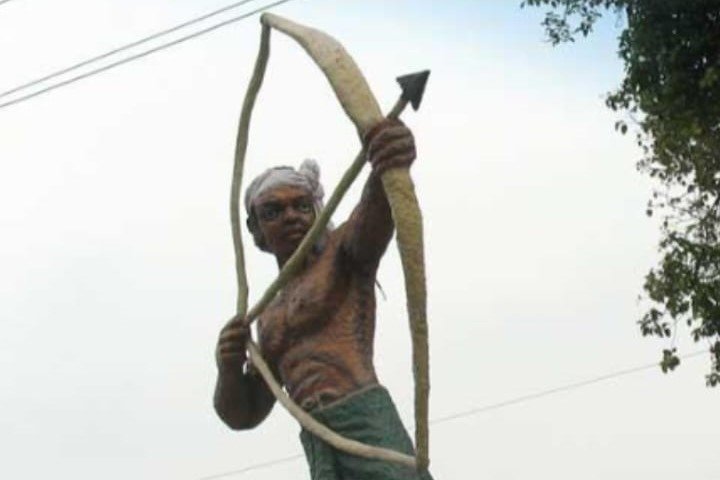
By Kumar Krishnan
Independence Day is not merely an occasion to recall the date on which India became free from colonial rule. It is also a time to remember the struggles and sacrifices that prepared the ground for freedom. While 1857 is generally regarded as the first major uprising against British rule, resistance to colonial authority had begun much earlier. In the hills of Rajmahal and the Santhal Pargana region, Tilka Manjhi emerged as one of the earliest and most enduring symbols of that resistance.
Nearly seven decades before 1857, Tilka Manjhi challenged British authority. His struggle was not simply against foreign rule. It was also a fight for the community’s rights over land, forests and livelihood. In that sense, his rebellion represented an early assertion of a principle that remains relevant today: a people’s right to control the resources on which their lives depend.
Before the expansion of the East India Company, life in the Rajmahal hills and forested tracts was shaped by a distinct social and economic system. The Paharia communities depended largely on hunting, gathering, shifting cultivation and forest produce. Wood, fruits, leaves and medicinal plants were not commercial commodities but part of everyday life and culture.
The Company’s expansion disrupted this equilibrium. New systems of revenue collection, land settlement and ownership created growing pressure on tribal communities. The colonial administration sought greater control over forests and hill territories and encouraged settled cultivation over shifting cultivation. Zamindars, moneylenders and intermediaries became part of this expanding system of extraction. The famine of 1769-70 further deepened the crisis.
The British response was not limited to military force. They also used incentives and administrative strategies to weaken resistance. Warren Hastings strengthened military arrangements in the region, while officials such as Augustus Cleveland sought to bring Paharia chiefs into the colonial system through rewards, recognition and patronage. Irregular forces such as the Hill Rangers were developed partly to use local fighting abilities in the service of British interests.
It was against this background that Tilka Manjhi’s rebellion took shape.
He challenged a system that treated tribal territories primarily as sources of revenue and administrative control. He organised his people and, according to local tradition, used knots tied in sal leaves as a means of communicating the message of resistance from village to village.
Between 1780 and 1785, resistance to British establishments and revenue operations intensified in parts of the region. British outposts, treasuries and their local allies became targets. Tilka Manjhi also sought to bring together Paharia chiefs and other communities. This gave his movement a significance beyond a local revolt: it reflected a wider social resentment against colonial intervention.
The historical record surrounding Tilka Manjhi’s identity and life contains variations. He is associated in several accounts and oral traditions with names such as Jabra Paharia and Jaurah Paharia. The term ‘Manjhi’ itself was used in tribal society for a village headman. Writers and historians have interpreted his life in different ways.
Mahasweta Devi wrote about Tilka Manjhi and his rebellion. Rajendra Prasad Singh’s book Tilka Manjhi also documents his life and struggle, while Ratanlal Joshi and other writers have helped preserve his memory in literature. Thus, alongside archival records, literature and oral traditions have played an important role in keeping his story alive.
One of the most remembered episodes occurred on January 13, 1784, when, according to popular accounts, Tilka Manjhi attacked Augustus Cleveland with an arrow. Accounts differ on the precise circumstances surrounding Cleveland’s injury and death, making it important to distinguish between documented history and later oral memory. Nevertheless, the episode became a powerful symbol of the challenge posed by Tilka Manjhi to colonial authority.
The British subsequently intensified military operations in the hills. Tilka Manjhi was eventually captured after a prolonged campaign. Popular tradition holds that he was dragged to Bhagalpur and hanged from a banyan tree in 1785. The Tilka Manjhi locality in Bhagalpur continues to preserve the memory of this resistance.
His execution did not end the resistance. Subsequent tribal uprisings across eastern India—including the Santhal Hul of 1855 and Birsa Munda’s movement of 1895-1900—became important chapters in the long history of opposition to colonial rule.
This is why India’s freedom struggle cannot be viewed only through the lens of 1857 and the political movements that followed. Long before modern nationalism acquired its vocabulary, communities were resisting the loss of their land, forests, livelihoods and autonomy.
Tilka Manjhi’s legacy also speaks directly to contemporary India. Questions over jal, jungle and zameen, displacement and control over natural resources remain part of democratic debate. The question he confronted more than two centuries ago still resonates: Who decides the meaning of development, and who pays its price?
To remember Tilka Manjhi this Independence Day is therefore to widen the meaning of freedom. India’s freedom story was not written only in capitals, legislatures and political movements. It was also shaped on forest paths, in the hills and through the resistance of communities that refused to separate their land from their identity.
Tilka Manjhi’s first call for freedom was a call for dignity, autonomy and the right to live on one’s own terms. That call remains an important part of India’s unfinished conversation about freedom.

