
Yoga as a Practice for Making Life Divine
PNS
Swami Kaivalyananda and Kumar Krishnan
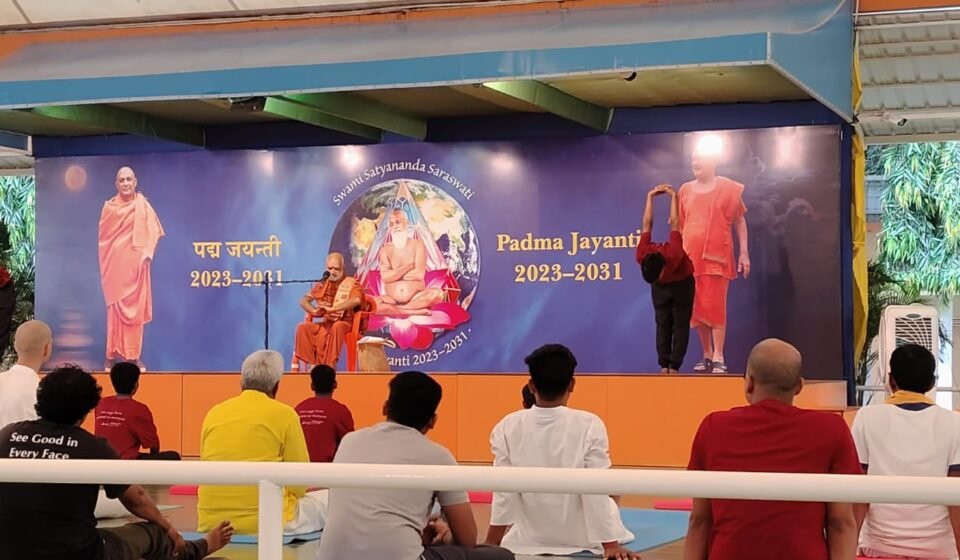
Munger. The 12th International Yoga Day was celebrated with great enthusiasm in the yoga city of Munger. Under the unique initiative “Yoga from the Ashram Premises to Home Terraces and Courtyards” by the Bihar School of Yoga, Munger, people of the yoga city were encouraged to gather with family or community members at home, in courtyards, or in any open space to practice yoga together. This initiative was started by the Bihar School of Yoga, Munger, alongside the declaration of International Yoga Day. Under this program, people unite at a designated time to perform special yoga practices prepared by the ashram for the entire year. Through this initiative, the ashram’s sannyasins and yoga instructors motivated practitioners to experience the simplicity and usefulness of yoga and to develop regularity in their practice
During the 12th International Yoga Day program at the Paduka Darshan of the Bihar School of Yoga, senior monk Swami Kaivalyananda conducted yoga practices in which a large number of people participated. The Bihar School of Yoga, Munger, inspired yoga practitioners to make kindness and goodwill the foundation of their relationships and activities. The session included recitation of the Mahamrityunjaya Mantra, Gayatri Mantra, and the thirty-two names of Goddess Durga. This was followed by the practice of Akarna Dhanurasana, Samakonasana, Dvikonasana, Eka Pada Pranamasana, Ardha Ustrasana, Shashankasana, Marjari Asana, Sarpasana, Kandharasana, Viparita Karani Asana, Matsyasana, and Shavasana, along with Nadi Shodhana and Bhramari Pranayama. In addition, methods of pratyahara were also practiced.
Swami Kaivalyananda said that yoga is not merely a means of keeping the body healthy but a divine discipline for making life balanced, harmonious, and aware in its entirety. These practices help achieve holistic health. The program also emphasized Yama and Niyama, inspired by Paramahamsa Swami Niranjanananda Saraswati. Under this, one Yama—kindness—and one Niyama—contentment—were selected as part of a yogic lifestyle so that efforts could be made to remain connected with virtues and spread goodness. Swami Niranjanananda Saraswati believes that if these are followed with awareness and dedication, not only one’s state of mind but also the surrounding environment can be transformed.
He said that Swami Satyananda Saraswati, a disciple of the great 20th-century saint Swami Sivananda and a pioneer of the global yoga movement, had recognized the potential of yoga and declared as early as the 1960s that yogic knowledge would emerge as a global culture and guide world events. Today, as the entire world faces unexpected challenges, his prophecy appears to be coming true. Yoga now enjoys worldwide recognition. In this, the Bihar School of Yoga and its Satyananda Yoga tradition, known as the Bihar Yoga system, have played a significant role. From the 1960s until 2012, the Bihar School of Yoga focused on spreading yoga globally. After the World Yoga Convention of 2013, Paramahamsa Swami Niranjanananda Saraswati initiated the second chapter of yoga. This was announced during the World Yoga Convention held in Munger in 2013 by Swami Niranjanananda Saraswati, the head of the Bihar School of Yoga.
Its objective is to connect traditional yoga with daily life, culture, and the modern age. Under this vision, emphasis is being placed on transforming yoga from merely a one-hour practice into a complete “yogic lifestyle.” To promote this, he continues to travel across different parts of India. The program concluded with hopes and prayers that the inspiration of yoga may remain alive in everyone’s life.