Inner Stability Comes Through Devotion and Spiritual Discipline Dedicated to God and the Guru: Paramahamsa Swami Niranjanananda Saraswati
Paduka Darshan Campus Immersed in Krishna Devotion
Three-Day Krishna Worship Ceremony Concludes with Peace Chants and Sacred Fire Ritual
By Kumar Krishnan
Munger, August 28. “Spiritual discipline does not mean merely bringing a ritual to its formal completion; its true purpose lies in assimilating its spirit into one’s life. One should deepen one’s reverence for God and the Guru, one’s love for the chosen Deity, and one’s sense of responsibility towards the values of life. Circumstances are ever-changing, yet devotion and spiritual discipline enable a person to remain inwardly steadfast.” Paramahamsa Swami Niranjanananda Saraswati said this while addressing devotees on Friday, the third and concluding day of the three-day Krishna worship ceremony organised during the Chaturmas observance at the Paduka Darshan precinct of the Sannyasa Peetha in Munger.
Speaking in the context of Raksha Bandhan, he said that protection is not confined merely to safeguarding another person. At its heart lie responsibility, trust and the preservation of relationships. To establish reverence for God and the Guru, and love for one’s chosen Deity, in one’s life is itself a spiritual resolve. When a person remains conscious of his duties and relationships, discipline and inner tranquillity gradually take root in his life.
He said that devotion to Krishna is not merely a mode of worship; it is a spiritual discipline through which life is imbued with love, surrender and equilibrium. Love for Lord Krishna inspires a person to accept life’s vicissitudes and yet remain poised amid them.
The swing of Krishna was interpreted as a symbol of this deeper spiritual truth. Its movement backwards and forwards evokes the vicissitudes of human existence—the alternation of joy and sorrow, success and failure, and the ceaseless flux of circumstances. Its cyclical motion also suggests the perpetual movement of life. When a devotee rocks the Lord in the swing, it is as though he entrusts the reins of his own life to the Divine. Such surrender steadies the mind amid anxiety and uncertainty. However violently the swing may move, the Lord seated upon it remains serene and joyful. In the same manner, one who abides in divine love may preserve inner peace amid the ceaseless movements of life.
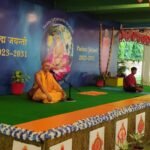
On the concluding day of the three-day Krishna worship ceremony, the Paduka Darshan precinct remained suffused with Krishna devotion, Vedic chants and spiritual practice. Devotees and seekers participated in collective prayers, recitations of sacred hymns, the fire ritual and devotional singing. The atmosphere was pervaded by such a current of devotion that the formal aspect of ritual receded, leaving the spirit of spiritual practice and surrender at the forefront.
The programme commenced with Vedic peace invocations and a Shanti Path. This was followed by a collective recitation of the Achyutashtakam, attributed to Adi Shankaracharya. As the assembled voices recited, “Achyutam Keshavam Rama-Narayanam, Krishna-Damodaram Vasudevam Harim; Shridharam Madhavam Gopikavallabham, Janaki-Nayakam Ramachandram Bhaje,” the entire precinct resonated with devotion. The hymn, invoking the diverse manifestations of Lord Krishna and Lord Vishnu, suffused the atmosphere with sacred emotion.
A sacred fire ritual was then performed, followed by the collective recitation of the 108 names of Lord Krishna. During the recitation of the Govinda Damodara Stotram, the devotees remained absorbed in devotion: “Shri Krishna Govinda Hare Murare, He Nath Narayana Vasudeva. Jihve Pivasvamritam Etad Eva, Govinda Damodara Madhaveti.” The recitation of the Madhurashtakam, followed by the devotional chanting of “Jai Hari Narayan Govind, Jai Ram Narayan Govind,” rendered the atmosphere still more deeply devotional.
The kirtan, “Kadamba ki dali, jhule Banwari, jhule Radharani, jhulave Radharani,” evoked the divine childhood pastimes of Krishna and the tender love of Radha and Krishna. The devotees swayed in devotion, while the Paduka Darshan precinct continued to reverberate with sacred song.
In his opening address, Swami Shivadhyanam said that Krishna worship had been observed for three days during the Chaturmas observance and that, on the concluding day, seekers and devotees had immersed themselves in the bliss of devotional sentiment. He said that devotion to Krishna awakens within a person the consciousness of love, compassion, surrender and balance. The true meaning of devotion, he added, ought ultimately to find expression in one’s conduct and daily life.
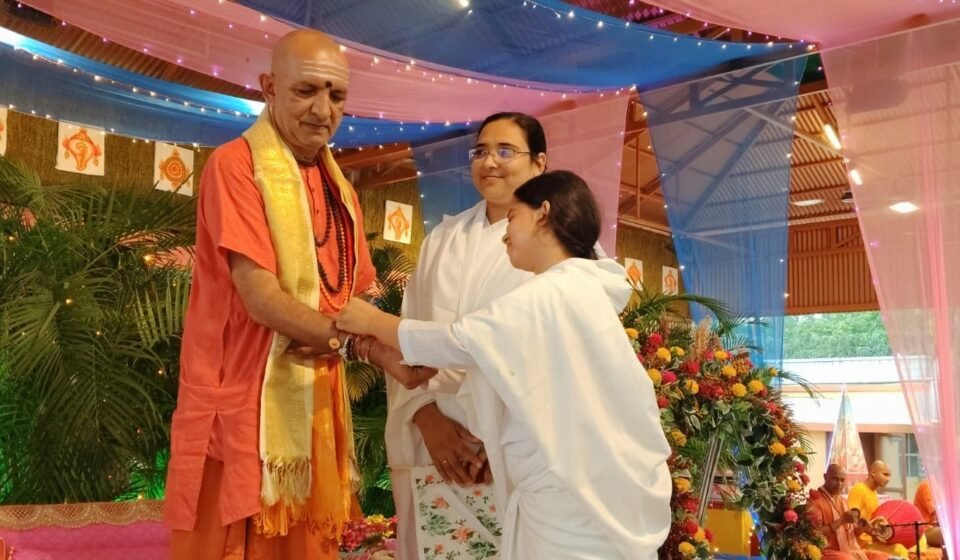
On the occasion of Raksha Bandhan, Sister B.K. Jaymala and Sister B.K. Harshita of the Prajapita Brahma Kumaris Ishwariya Vishwavidyalaya, Munger, tied sacred rakhis on Paramahamsa Swami Niranjanananda Saraswati. The gesture transcended the conventional bond between brother and sister and became a symbol of spiritual protection, trust and responsibility. This intimate observance of Raksha Bandhan also underscored the dignity of human relationships within an atmosphere steeped in Krishna devotion.
The concluding day of the three-day Krishna worship ceremony, held in the presence of Paramahamsa Swami Niranjanananda Saraswati, came to an end with peace invocations, the sacred fire ritual, collective recitation of hymns and devotional chanting. Amid the resonance of Vedic mantras and Krishna bhakti, the ceremony concluded with the enduring message that however swiftly life may move and whatever vicissitudes it may bring, love for God, reverence for the Guru and the spirit of surrender possess the power to keep a person inwardly steadfast.