
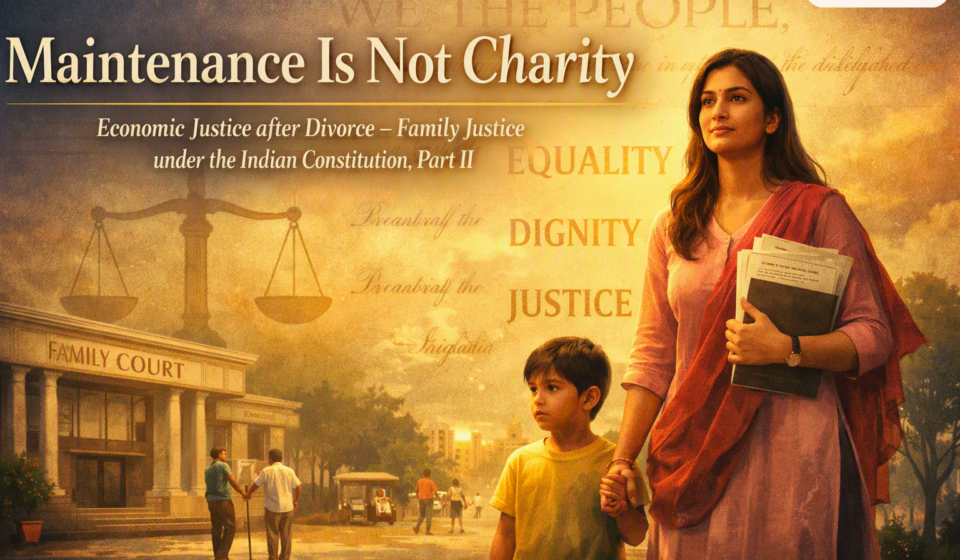
Maintenance Is Not Charity: Economic Justice after Divorce
Family Justice under the Indian Constitution – Part II
By Richa Sanchita, Advocate, High Court of Jharkhand
When a marriage ends, the emotional consequences are often visible, but the financial consequences can be equally devastating. For many women who have devoted years to raising children or managing the household, divorce may suddenly mean the loss of financial security. In such situations, maintenance is frequently misunderstood as a favour or a penalty imposed on one spouse. Indian law, however, treats maintenance very differently—it is a legal right rooted in the constitutional ideals of equality, dignity and social justice.
The Constitution of India does not expressly mention maintenance, yet Articles 14, 15(3), 21 and 39 collectively provide its philosophical foundation. Equality before law, the right to live with dignity, and the State’s obligation to protect women and children require that no person should be reduced to destitution merely because a marriage has failed. Maintenance is therefore not charity; it is a mechanism to ensure that economic inequality does not defeat constitutional justice.
The legal framework governing maintenance is spread across several statutes, including the Hindu Marriage Act, 1955, the Hindu Adoptions and Maintenance Act, 1956, the Protection of Women from Domestic Violence Act, 2005, and the Bharatiya Nagarik Suraksha Sanhita, 2023. Together, these laws enable courts to grant interim and permanent maintenance to an eligible spouse and provide financial support for children. The objective is not to reward one party or punish the other, but to preserve a standard of living consistent with dignity and fairness.
Recognising the absence of uniformity in maintenance orders across the country, the Supreme Court in Rajnesh v. Neha (2020) laid down comprehensive guidelines that have become the cornerstone of maintenance jurisprudence. The Court directed parties to make truthful disclosure of their income, assets, liabilities and standard of living, enabling courts to determine maintenance on objective criteria rather than conjecture. It also emphasised that prolonged delay in deciding maintenance applications defeats the very purpose of the law, as immediate financial relief is often crucial for the survival of the claimant.
The judgment in Rajnesh v. Neha also addressed another practical difficulty—multiple maintenance proceedings under different statutes. The Court held that maintenance awarded under one legal provision should be disclosed in subsequent proceedings to prevent conflicting orders while ensuring that the claimant receives adequate support. The emphasis was on fairness, transparency and judicial consistency.
Long before this, the Supreme Court in Bhuwan Mohan Singh v. Meena (2015) reminded courts that maintenance proceedings are a measure of social justice. Observing that a wife should not be compelled to suffer financial hardship because of avoidable litigation, the Court stressed that the purpose of maintenance is to enable her to live with dignity rather than merely survive. Delays, the Court cautioned, undermine both the object of the law and the constitutional promise of justice.
Another important decision is Shailja v. Khobbanna (2018), where the Supreme Court clarified that the mere fact that a woman is educated or capable of earning does not automatically disentitle her from maintenance. The relevant consideration is whether she has sufficient independent income to maintain the standard of living that the law seeks to protect. This ruling recognised the social reality that many qualified women may be unemployed, underemployed or financially dependent despite possessing educational qualifications.
The judiciary has also consistently held that maintenance cannot become a tool for either exploitation or evasion. Courts assess the income, liabilities, health, age, responsibilities and financial needs of both parties before determining a just amount. A spouse cannot deliberately suppress income or evade legal obligations. Equally, maintenance should not become a means of unjust enrichment. The guiding principle remains fairness, balancing the rights and responsibilities of both parties.
Importantly, maintenance is not confined to wives alone. Hindu law also recognises the rights of dependent children and, in appropriate circumstances, aged parents to claim maintenance. This broader approach reflects the constitutional commitment to social welfare and family responsibility. It reinforces the idea that economic justice within the family is an essential component of a just society.
Despite progressive judicial pronouncements, implementation remains a challenge. Maintenance proceedings often take months, if not years, to conclude. Non-compliance with court orders, concealment of assets, and repeated adjournments frequently leave deserving claimants in financial distress. Family courts require greater institutional support, effective enforcement mechanisms and digital systems for prompt disclosure of financial information.
As Indian society changes, the understanding of maintenance must also evolve. Women increasingly participate in the workforce, yet many continue to shoulder disproportionate caregiving responsibilities. The law must recognise unpaid domestic work as a valuable contribution to the family economy. Marriage is a partnership, and when that partnership ends, the economic consequences cannot fall unfairly upon one party alone.
Maintenance is not an act of generosity. It is an expression of constitutional compassion, substantive equality and social justice. A legal system committed to dignity cannot permit economic abandonment to become the price of divorce.
The true test of family justice is not simply whether marriages endure, but whether those emerging from failed marriages can rebuild their lives with security, dignity and hope.
Next Week: Child Custody: Courts Protect Children, Not Competing Parents.
Richa Sanchita is an advocate of Jharkhand High Court with more than 24 years of experience. Her area of expertise are Civil, Writs, Criminal and Banking.