
The Thin Line Between Self-Respect and Ego: Why Anger Defines Us
By Nidhi Sharma Singh
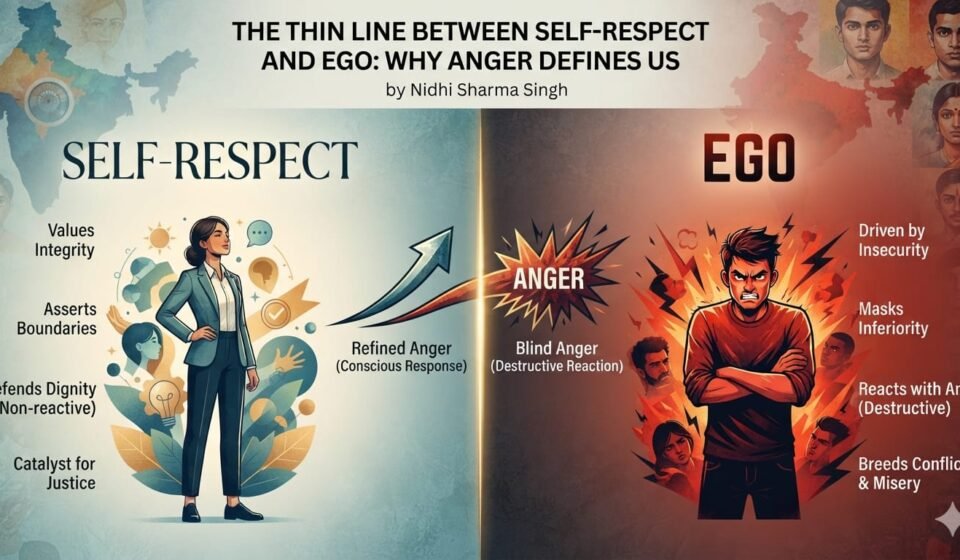
With its 1.42 billion people, is a nation of contradictions. One of the most striking traits of our collective psyche is the belief that we rarely do wrong — not because we are inherently virtuous, but because we often fail to distinguish between right and wrong. We see only one side of the coin and mistake it for the whole truth.This reminds me of the timeless parable of the blind men and the elephant. Each man touched a different part of the animal — trunk, ear, leg, body, tail — and each described it differently: a rope, a wall, a column, a sheet. None were entirely wrong, yet none were entirely right. Truth, like the elephant, is larger than any single perspective.When perspectives clash, anger often follows. But anger is not born of superiority; it is rooted in insecurity. What psychology calls a “superiority complex” is often nothing more than an inferiority complex turned outward. Arrogance, too, is simply a shortcoming — not something worth our resentment.The real challenge lies in navigating the razor-thin line between self-respect and ego. When we fail to recognize this distinction, anger consumes us. Yet anger itself is not inherently destructive. In fact, it is universal — present in every Indian, perhaps in every human being. The question is not whether we feel anger, but when, why, and on whom we choose to express it.Used wisely, anger can be a tool for justice, a catalyst for change, and a defense of dignity. Used recklessly, it becomes corrosive, breeding conflict and misery. Life becomes easier, even comfortable, when we master this discernment.India’s challenge, then, is not to suppress anger but to refine it — to transform it from blind reaction into conscious response. Only then can we move beyond partial truths and see the whole elephant.
(Nidhi is a child psychologist)