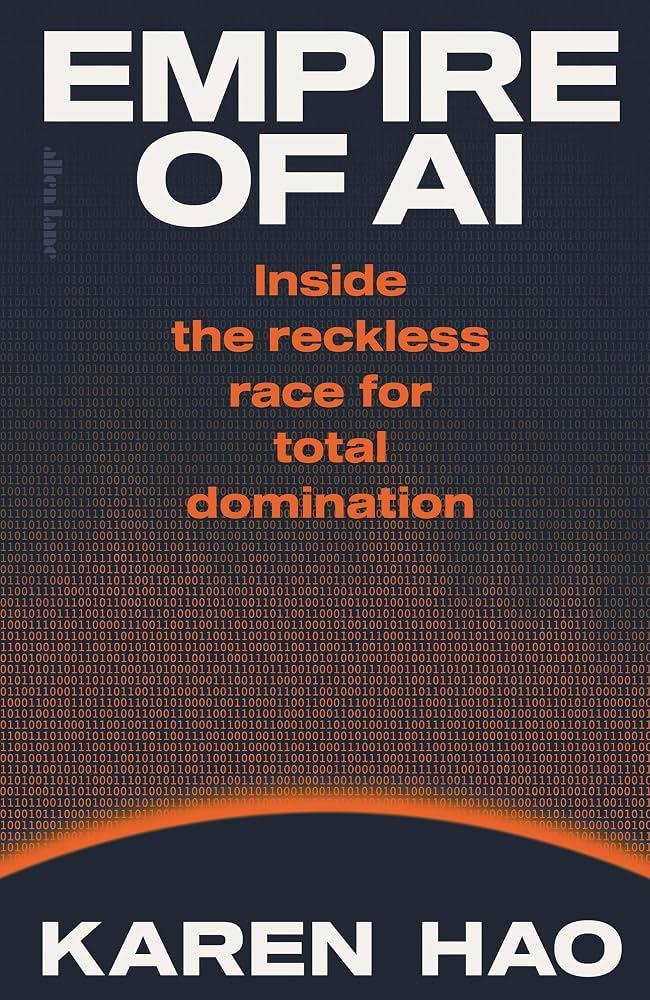

Book Review: EMPIRE OF AI (Penguin Books, 2025)
By AJAY KUMAR SINGH
Modern cognitive science has come a long way since the controversial British mathematician Alan Turing declared in 1950 that machines could think and that the human brain was in large part a digital computing. Turing proposed what subsequently became known as the ‘Turing Test’ as a criterion for whether a computer can think, that is, whether within a fixed timeline a remote human interrogator could distinguish between a computer and a human subject based on their replies to various questions posed by the interrogator. By means of a series of such tests, called the ‘imitation game’ , a computer’s success at thinking could be measured by its probability of being (mis)identified as the human subject. It remained a classic origin story among people working in AI until the launch of ChatGPT in November 2022 quite vindicated the Turing test. Not surprisingly, books on AI has since then been the flavour of the season.
When I first encountered Karen Hao’s Empire of AI: Inside the reckless race for total domination, the immediate gut feeling was that the bestseller from an acclaimed American tech journalist, having covered most of the artificial intelligence stories of our generation, would be worth a shot. Once finished I stand vindicated as well as amazed by the gripping storytelling that has quite shaped my understanding of OpenAI, the company which is at the centre of the AI revolution. The prologue sets the pace with some rich behind-the-scene details on Open AI’s high-profile CEO Sam Altman’s brief ousting and dramatic reinstatement in 2023.
The book contains a dense 450 odd pages with crisp chapter wise notes towards the end. It’s a definitive inside account of how OpenAI, the company behind ChatGPT, transformed from an idealistic non-profit co-founded by Elon Musk to a for-profit empire with Sam Altman at its manipulative, charismatic centre. Hao’s book draws on more than 300 interviews with current and former OpenAI employees, insiders at Microsoft, Meta, Anthropic and Google, and countless leaked emails and Slack messages.
One of the most urgent questions of our generation has indeed been how to govern artificial intelligence and control the intoxicating power of such a paramount technology. The founders of OpenAI, being the pioneer AI company, began with a radical commitment for developing the so-called ‘artificial general intelligence’ not for financial gains but for the larger benefit of mankind. As the goal was to do good to the world so democratic participation in the technology’s development became the key. Openness was the objective, hence the name OpenAI.
It soon became evident though that OpenAI was not an altruistic project but rather one of selfishness and ego. Elon Musk parted ways in early 2018 and took his money with him. The loss of its primary backer pushed OpenAI into financial uncertainty leading Sam Altman to turn the company for-profit and, a little later, to join hands with Microsoft’s Satya Nadella. As private fundraising and heavy market demand has since driven OpenAI’s valuation past $ 850 billion, Microsoft continues to be its biggest shareholder holding a vital 27% equity worth roughly $135 billion.
Hao clarifies many concepts, people and timelines in the AI universe. For example, she describes Musk’s role early on and his reasons for leaving, mainly the power struggle with Altman for control and the differing directions the company needed to take to compete against Google. Musk’s paranoia about DeepMind’s Demis Hassabis was the main trigger for the initial partnership. Dario Amodei’s falling out with Altman, along with his sister and several other senior OpenAI employees, due to their differing views on AI safety is described in detail, especially concerning the commercialization of OpenAI and Amodei’s founding of Anthropic. The author also explains how Ilya Sutskever, chief scientist and co-founder of OpenAI, left over similar safety concerns to form his own company, Safe Superintelligence Inc. and how Mira Murati, former CTO, quit to form Thinking Machines Lab. Many of today’s AI superstars were originally consolidated within OpenAI only to splinter out into various AI companies.
Hao contextualizes the struggles within OpenAI as an ideological conflict between Boomers (AI accelerationists) and Doomers (AI safety advocates). Many Doomers were sceptical about having Sam Altman as the leader of the company that posited to usher in artificial general intelligence (AGI), especially after his wilful neglect of safety and alignment concerns. AGI was rightly perceived as a powerful transformative technology, similar to the atomic bomb, that would give ultimate power to the company that develops it. And it was also widely believed that AI or AGI would be whatever OpenAI desired. In this scenario the company leader isn’t just a CEO but rather one who makes god-like decisions that will shape society. Given his self-serving pursuit of power and his compulsive dishonesty, many of Altman’s colleagues felt he wasn’t the right leader for handling such a disruptive technology.
Hao tells us that apart from the ideological conflicts other tensions brewing inside OpenAI were often fueled by Altman’s untrustworthy character. She describes Altman as an astute psychological observer who listened carefully to people to understand what they wanted, then promised to deliver on those wants, only to do the same for others with opposing views. For those who opposed his agenda, he would quietly work to fire them from the company. The famous comment that Altman was ‘not consistently candid’ (made during Altman’s temporary firing) is a characterization that becomes fully understood in the context of his many deceits and false promises. For the most part, Altman aligns more with the commercial enterprises of the Boomers than the AI safety concerns of the Doomers.
One interesting argument proffered is that OpenAI is following similar colonial patterns as empires of the past. The author describes four patterns of empire methodologies. First, the ideological justification. Using a grand yet vague mission, building AGI for the ‘benefit all of humanity’ to justify their actions, much like past empires used a ‘civilising mission’. This narrative, often referred to as a ‘good empire vs evil empire’ race (e.g. against China), serves to rally talent and capital while deflecting from more immediate ecological harms of the AI data centres. Second, the resource seizure, that is, claiming resources that aren’t their own, which includes data from the internet as well as natural resources like water and energy. Third, the labour exploitation. Exploiting low-wage content moderation and data annotation ghost work in places like Kenya. And finally, knowledge manipulation, that is, by concentrating top AI researchers within a few corporations. During the last decade Microsoft and Google more than tripled their corporate-affiliated research labs, poaching the best talent from the academia. The recent exodus of AI research faculty from American universities to tech industry has been phenomenal.
Once finished the book will not leave the reader with good vibes about the AI industry or suggest that infinite possibilities like cures for cancer, climate change solutions, etc. are ready to be unlocked through Artificial General Intelligence. The book will instead ground him in the real concerns about AI’s potentially damaging impact on the many societies and environments outside of Silicon Valley, the same societies and environments that provide the support and resources needed for its development. The book is indeed, as The Times noted, “one part explainer of the tech behind the race, another part an account of the human drama of OpenAI’s rise, and a third part a condemnation of how OpenAI plunders environmental and human resources… a well-written and useful history of the mania surrounding artificial intelligence “.
(The writer is a former IAS officer and currently working as Head Corporate Affairs for Jindal Steel in Jharkhand)