
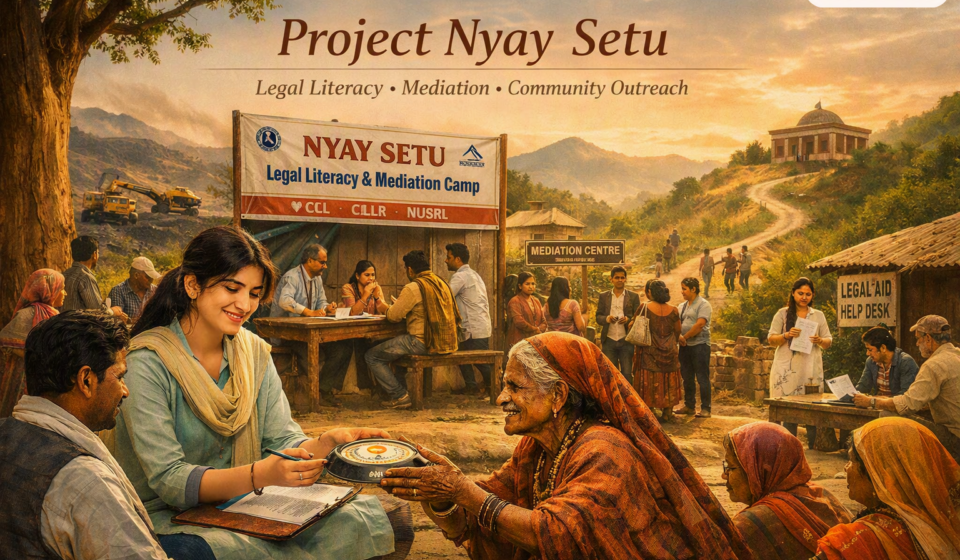
Bridging the Last Mile of Justice: Project Nyay Setu and the Road to Inclusive Access
A collaborative CSR initiative of Central Coalfields Limited, CLLR and NUSRL Ranchi, Project Nyay Setu brings mediation, legal literacy and grassroots engagement closer to communities while revealing the persistent barriers between rights and their realisation.
By Dr. Shweta Mohan, Dr. Shantanu Braj Choubey, Ms. Kanu Priya
When Justice Exists, But Remains Out of Reach
The most difficult barrier to justice is not merely the absence of law. More often than not law exists, the entitlement is real, and a remedy is available yet the person who needs it simply doesn’t know how to reach it. For a villager living in remote areas, government offices, courts and legal institutions, the gap between having a right and actually exercising it can be enormous.
Across Jharkhand, this distance is defined by a variety of factors like limited legal literacy, lack of access to justice, difficulty to access information, lack of digital access, remoteness and difficulty in the follow-up process. A person may be eligible for any government benefit yet remain excluded, a worker can face exploitation despite having the fundamental rights, or a family may have a dispute which can be potentially resolved via mediation, but may never reach an appropriate forum.
It is this missing link in enunciating rights and realisation that makes Project Nyay Setu, a joint CSR project of Central Coalfields Limited (CCL), Centre for Labour Law and Research (CLLR) and National University of Study and Research in Law (NUSRL) Ranchi, significant. The Centre functions under the patronage of Prof. Dr. Ashok R. Patil at the National University of Study and Research in Law (NUSRL).
The significance of this initiative goes far beyond conducting camps and raising awareness. It lies in recognising that access to justice begins much before a person enters a courtroom perhaps through a discussion, an explanation of a right, assistance in identifying the right forum or simply the opportunity to have a grievance heard.
Nyay Setu seeks to build precisely that bridge: between the promise of rights and the reality of accessing them.
From the Idea of Justice to the Ground Reality
The heart of the Project Nyay Setu lies in its approach of translating its objectives into direct community engagement. The project puts emphasis on providing opportunities for people to voice their issues, get some initial advice, learn what remedies are available to them, rather than treating legal awareness as a one-off dissemination of information. The establishment of mediation camps, legal-awareness programmes, community interaction and structured field surveys are, as a result, instruments of intervention as well as listening. The programmes also consist of Street play (Nukkad Natak) to make workers aware of their legal rights.
Justice efforts ought to be judged not only by the number of camps they hold, but the lessons they teach about those they have hoped to serve. Project Nyay Setu’s outreach is designed around a 12-block network spanning Khelari, Burmu, Kanke, Ratu, Ormanjhi, Chanho, Ramgarh, Patratu, Chitarpur, Dulmi, Gola and Mandu across Ranchi and Ramgarh districts. These mediation camps have started to show a pattern which is more complex than individual disputes. The nature of the complaint can vary from block to block, but many of the complaints are related to the same issue: the gap between legal rights and exercised rights.
For example, at Kanke, the grievances that were taken up before the team went beyond mere conflicts. Issues of child labour also came up with some problems relating to widow pensions, pension delays and irregularities, and other problems due to economic and social vulnerability. The following complaints show that access to justice is frequently linked to access to livelihood, social security and basic welfare.
There was an added dimension to this field engagement at Burmu. The camp included information gathering and discussion about mediation issues, as well as the recording of community barriers. The significance of this exercise is that it helps to move beyond the sphere of individual complaints to patterns that could need sustained institutional interventions. An individual grievance can get lost in the administrative shuffle while a cluster of grievances may indicate a systemic problem.
All the above experiences combine to illustrate one key takeaway: The justice gap is seldom caused by a single missing law. It is formed by several smaller gaps that build up between the citizen and the institution.
This is where the field work of Nyay Setu becomes important. It does not just ask, “What rights does the law provide?” It also poses the tougher question of “What stops those rights from extending to the person they were created for?”.
From Identification to Intervention: Building a Pathway to Justice
The real test of a grassroots justice initiative begins after a grievance has been heard.
Listening is important, but listening without the pathway to action can result in the same uncertainty with which they arrived. Project Nyay Setu, therefore, aims to insert a few layers between the initial articulation of a problem and its potential solution i.e. understanding the grievance, determining the remedy for the problem, offering some preliminary guidance, exploring mediation where applicable, and linking matters requiring formal action with the institutions that can resolve them.
At the end of the day, this project is ultimately the collective effort of people who strongly feel that legal education needs to transcend beyond the confines of the institution.Perhaps one of the most significant strengths of this collective engagement is that justice is a shared responsibility and not the responsibility of any one institution.


Dr. Shweta Mohan, Dr. Shantanu Braj Choubey, Ms. Kanu Priya