
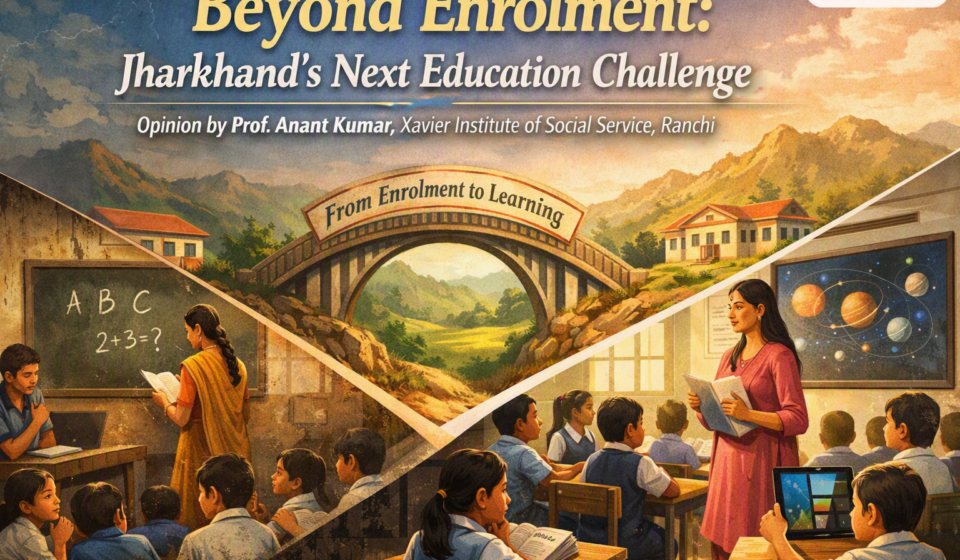
Beyond Enrolment: Jharkhand’s Next Education Challenge
OPINION
By Prof. Anant Kumar
NITI Aayog’s SDG India Index 2023-24 identifies four states as lagging on Goal 4: Quality Education. These states are Bihar, Uttar Pradesh, Jharkhand, and Odisha. As NITI Aayog’s CEO put it when releasing the index, “access to schools is not an issue; it’s the quality.” Jharkhand has spent the last decade solving the first problem. It has barely begun solving the second.
Another NITI Aayog report, released in May 2026 and drawing on a full decade of UDISE+ data, recorded that Jharkhand’s primary school dropout rate fell to zero in 2024-25, down from 6.41 per cent in 2014-15. Upper primary dropout fell from 7.42 to 1.7 per cent, and secondary dropout from 23.2 to 3.5 per cent, placing Jharkhand fourth-best in the country on this measure. Electricity access in schools rose from just 14.7 per cent to 92.7 per cent over the same decade. These are not small achievements, and the temptation to treat them as the whole story is understandable.
Jharkhand’s Gross Enrolment Ratio (GER) at the higher secondary level is just 48.6%, one of the lowest in India, meaning fewer than half of the 16- and 17-year-olds are in Classes 11 and 12. The transition rate from Class 5 to 6 is 89.6%, below the national average of 92.2%. Even fewer, 81.3%, of children completing Class 8 move to Class 9, versus 86.6% nationally. While enrolment retention is high, many students do not advance to the next stage of schooling.
Jharkhand has nearly a lakh sanctioned teaching posts lying vacant, the bulk of them at the elementary level, and around 9,172 schools in the state are run by a single teacher for every grade and subject. No enrolment drive, however well executed, can substitute for a teacher physically present in every classroom. A child retained in a single-teacher school, who moved from grade to grade with minimal actual instruction, satisfies the dropout statistic while failing on quality.
SDG 4 calls for “inclusive and equitable quality education” that delivers “relevant and effective learning outcomes.” Scheduled Tribe children in the state have a Primary GER of 103.4 per cent, higher than the state average and the national ST figure. By the higher secondary level, the ST GER in Jharkhand falls to just 42.2 per cent, below both the state’s already-low overall figure and the national ST average of 51.9 per cent. Tribal children in Jharkhand start school alongside everyone else but then fall behind faster than their peers, a concern highlighted by SDG 4.
A state that eliminated its primary dropout rate over a decade while electrifying 9 out of 10 of its schools has done real work that deserves recognition. But the honest criticism is that the state has been measuring and rewarding the easier half of the problem, while the harder half, whether a child in Class 9 can actually read at grade level, has received far less attention.
The state must take three actions to achieve the SDG goals by 2030. First, teacher recruitment must be prioritised as urgently as enrolment campaigns have been. Second, the state needs to track and publicly report the Class 8-to-9 transition rate with the same seriousness it has applied to the dropout figure, since this is precisely where children are quietly disappearing from the system without being counted as dropouts. Third, since tribal children are disproportionately lost at the secondary stage, Jharkhand’s education planning and its tribal welfare planning need to be integrated into a single programme rather than being operated by two departments.
Jharkhand has proven it can get children into classrooms and keep them there through primary school. The next five years must focus on their retention, progression to higher grades, and quality education.
The author is a Professor at Xavier Institute of Social Service, Ranchi. The views expressed are personal.
Email: pandeyanant@hotmail.com