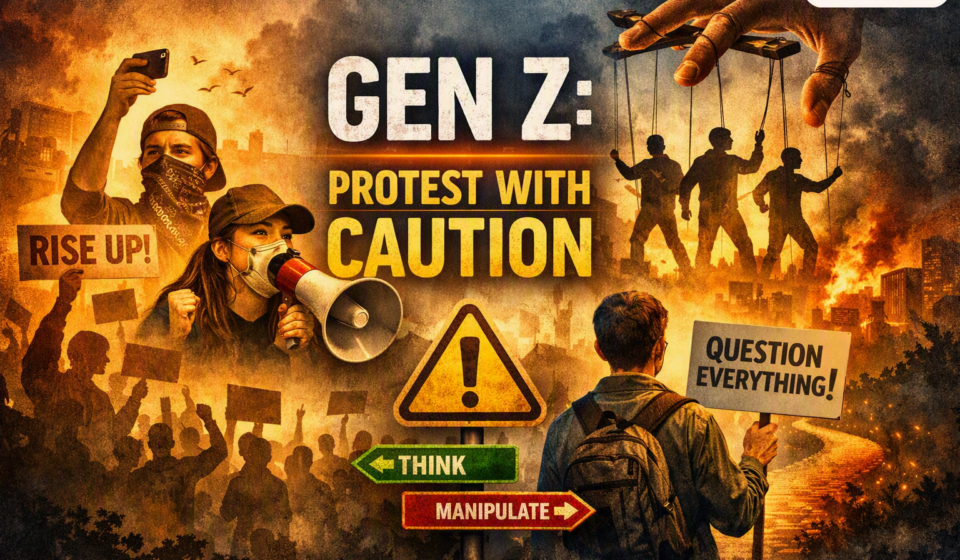
Gen Z: Protest, But Don’t Become Political Raw Material
Mahesh Poddar, Ex- MP, Rajya Sabha and Entrepreneur
India’s demographic strength is often described as its greatest advantage. More than half of our population is young, energetic and increasingly connected. Whether this becomes India’s greatest democratic strength or its greatest vulnerability depends upon how this generation chooses to engage with public life. Every generation of students has contributed to strengthening our democracy—whether during the freedom movement, the struggle against the Emergency, or several public movements that compelled governments to listen. A democracy where the youth stop asking questions is a democracy that begins to age. One can say Pre 2014, it was at that stage.
Yet, history also teaches another lesson—one that deserves equal attention. Whenever young people enter public life with passion and conviction, Politics naturally enters with organisation, leadership and competing interests. AAP is one such example. Sustained delivery mechanism is a challenge.
This is not a criticism of politics. It is its nature.
Having spent decades in industry, entrepreneurship and public life, I have learnt that every system follows predictable incentives. Politics is no exception. Every public movement, irrespective of ideology, passes through a chain—an issue creates emotion, emotion creates mobilization, mobilization attracts media attention, media attention generates political pressure, political pressure influences negotiations, and negotiations ultimately shape power and policy.
The uncomfortable question is: where do students stand in this chain? And also a question “student” how many types are they. Very often, they provide the energy. Others negotiate the outcome.
This is not unique to one political party. Nor is it unique to one ideology. It has happened across decades, across governments and across movements. History repeatedly reminds us that while young people often become the face of public mobilization, they are not always the architects of the final political settlement. Other issues also surface.
The methods, however, have changed dramatically. Earlier generations were mobilized through public meetings, pamphlets and organizational networks. Today’s generation is mobilized through algorithms, hashtags, short videos and influencers. Earlier, rumours travelled slowly. Today, emotions travel instantly. Technology has democratised communication, but it has also made mobilization easier than verification. 2014 – BJP won much ahead, Others were indifferent.
This is where Gen Z faces a challenge that no previous generation encountered. (Voting is another ballgame)
The battle today is not merely for votes; it is for attention. Every political party, advocacy group, digital campaign and ideological ecosystem competes for the attention of young citizens. In the digital economy, attention has become political capital. Whoever captures attention often shapes perception.
Young minds therefore carry an enormous responsibility. Before joining any campaign, asking a few uncomfortable questions is not cynicism; it is citizenship.
Who framed the issue? Have I understood the original facts, or only social media summaries? Who is setting the narrative? Who is financing the campaign? Who will negotiate with the government? Who bears responsibility if events turn violent? And after the television cameras move away, who will continue working for the cause? Social, financial, language barrier etc does not exits
These questions are not meant to discourage participation. They are meant to protect independent thinking.
As an entrepreneur, I have also observed another interesting parallel. Value creation and value capture are often different. The people who generate energy are not always the people who shape the final outcome. Public movements sometimes follow the same pattern. The people who generate energy are not always the people who shape the final outcome. Public movements sometimes follow the same pattern. Politics can work in much the same way. Students often create the moral energy of a movement. The political dividends, however, may be harvested elsewhere. Recognizing this possibility is not distrust—it is maturity.
None of this should be misunderstood as an appeal for political indifference. Democracies need politically aware students. Governments must continue to face informed questions from young citizens. Constructive dissent has strengthened every mature democracy.
But there is an important distinction between participating in politics and becoming someone’s political instrument. First, it a serious public business.
Support causes, not personalities.
Question every government, but question every opposition as well.
Read original documents. Read policy drafts. Read court judgments where relevant. Above all, understand the constitutional framework before accepting simplified narratives. Demand accountability even from those who claim to represent your interests. Above all, preserve your intellectual independence.
Political parties will come and go. Issues will change. Elections will be won and lost. But the credibility of India’s youth is a national asset that must never be compromised.
The greatest contribution Gen Z can make to Indian democracy is not louder slogans or larger crowds, but by informed citizens. Protest when conscience demands it. Participate when duty calls. But never surrender your independent judgment to any ideology, organization or political personality. A strong democracy requires citizens who think before they react, verify before they amplify, and serve the nation before serving narratives. Don’t be political Raw Material.