
Need of the hour: Protection of a less known Palash species
By Sudhanshu /Bandana
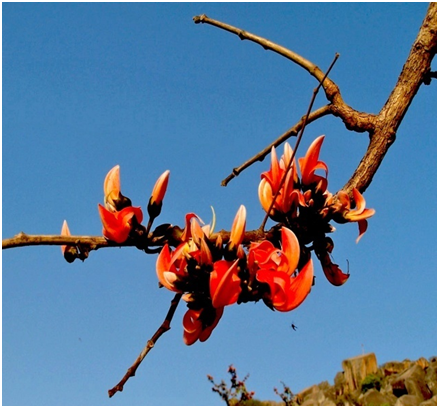
‘Palash’ (Butea monosperma) is the state flower of Jharkhand. Four species of Palash has been reported by great british botanist H.H.Haines(1921-25) in Jharkhand. Authors have collected three of them. Here we are throwing light on Butea parviflora DC., now with a changed name Spatholobus parviflorus (DC.) Kuntze which is less known to people.
It is a climber generally grows on slopes and along riverbanks. Unlike the fire red color flower of Butea monosperma (Lam.)Taub.(Palash) and Butea superba Roxb. (Lat palash),It has pinkish white flowers that grows in panicles. It is a species of least occurrence in Jharkhand. Locally it is called ‘Bandu’ but Oraon tribe call it ‘Murdha’. It is also called ‘Larang palash in near by of Patratu areaThe objective of this article is to find the cause of decline in the population of this plant in the area and also to know its various ethno botanical uses.
The plant Butea parviflora DC. is a woody climber having three leaflets. Middle leaflet is slightly larger in length. Flowers are in panicles and pinkish white or creamish in color. Young pods are initially light crimson in color which gradually turns brown . Seed-pods are thick woody, rounded at tip and covered with densely brownish soft short hair. Seeds are kidney-shaped and round .
Ethnobotanical uses:
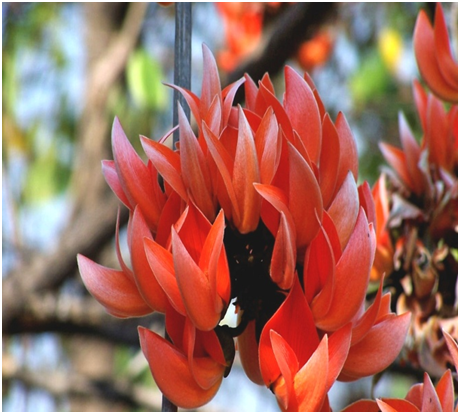
Local people especially Oraons make ropes from the fiber obtained from bark of – Butea parviflora. The bark is also used to tide the fire wood bundles directly.
The leaves are boiled with the fern Lygodium sps. (Mahadeo Jata) and this decoction is applied physically and orally both to get relief from pain in case of muscle cramps.
Cooking oil is obtained from the seeds which are used especially in preparation of local sweets like ‘Gulgula’.
This seed oil is applied on the hairs as tradition specially before attending an auspicious occasion.
A red gum exudes from the plant and can be extracted from the wood which is rich in tannins, that is used medicinally, as a tannin agent and as a dye.
The bark contains around 1% rotenone which can be used as an insecticide .).
Causes of decline in population:
Each pod is having only one seed at its anterior end. Some of the Pods show pore like wounds at this end. These pores are created by insectan larvae which feed on Cotyledons of the Seed leaving glass like resin over the pores This makes the seed damaged, affecting its germination.
All of these anthropogenic activities like seed oil extraction, making ropes for tiding purpose and use of its bark as fuel leads to the declining of the plant population in this area.
Therefore, the present study reports the above mentioned cause behind the declining population of Butea parviflora DC. Syn. Spatholobus parviflorus (DC.) Kuntze species in the forest of Ranchi district and there is urgent need to conserve this plant
(Both the writers are Ranchi University Professors)