
How the Humble Glow of a Lantern Earned a UNESCO Award
Down Memory Lane- IX
By GAUTAM SARKAR
Place & Time: A late evening in the early 1990s when entire South Bihar was burning with separate statehood movement.
In the village in Johar Sthan (sacred Santhal worship site where village assemblies are traditionally held) or the veranda or courtyard of a Durga or Manasa temple in the remote villages of Dumka district, otherwise most backward region in undivided Bihar.
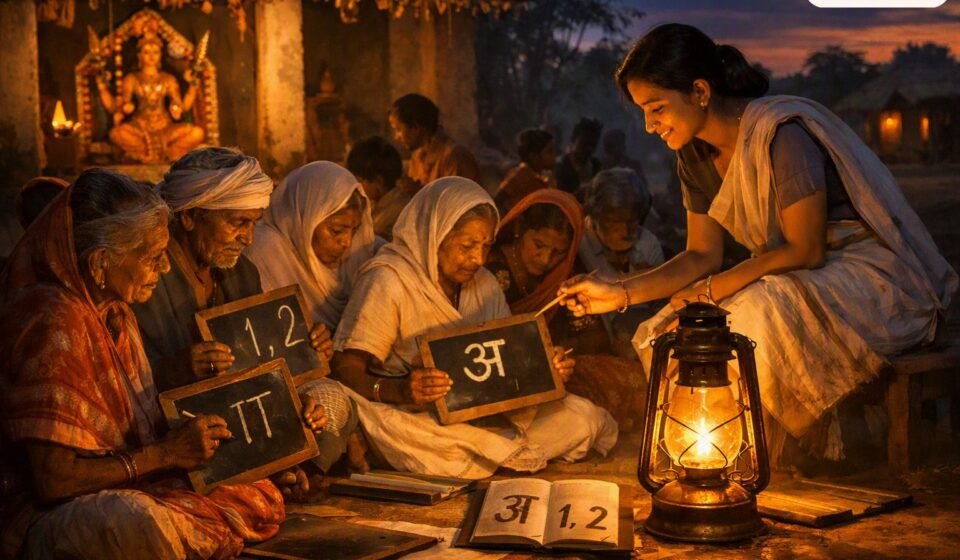
Gathered around the dim glow of a single lantern sat a group of elderly villagers, most of them women, clutching slates and slate pencils as they struggled to write their first letters Aa – Aaa or the numerals 1 and 2. Beside them stood a lone instructor, in most cases a young woman, patiently guiding them through the basics of reading and writing.
As a reporter of The Times of India, while returning from Jamtara, I witnessed remarkable scene in several villages of Nala and Kundhit blocks that night. I was deeply astonished, asked the villagers, they told me that a district-wide campaign was underway to make every village literate under a government initiative.
On my way back to Dumka late that night, my journalist’s mind was filled with questions. Coincidentally, that night I met the then Deputy Commissioner of Dumka, Anjani Kumar Singh (later become the Chief Secretary of Bihar), on the road.
That night, armed with the inputs I received from Anjani Babu as he was affectionately known, and after travelling through several villages in Kathikund Block, inhabited predominantly by the Santhal and Paharia tribal communities, I found an abundance of material for writing remarkable stories.
After dusk descended upon those villages, in the absence of electricity, the light of a simple kerosene lantern became the illumination under which the backdrop of a revolutionary chapter of history was being transformed, thousands of adults learned to read and write, was the punch line of the episodes.
The Akhilbatti Literacy Campaign ( Akhil meaning – continuous flam and batti means – lamp) of Dumka remains one of the most remarkable people’s education movements in the history of undivided Bihar. Conducted during the early and mid-1990s under the Bihar Education Project (BEP) and the National Literacy Mission (NLM), the campaign transformed literacy from a government programme into a genuine mass movement. Its success attracted national attention and earned Dumka prestigious recognition, including the UNESCO International Literacy Award and the Satyen Maitra Memorial National Literacy Award through the National Literacy Mission.
The challenge was not merely illiteracy in Dumka like backward region. It was poverty, isolation, linguistic diversity, and the absence of evening lighting. Most adults worked in fields throughout the day, leaving only the night for education. That limitation inspired the movement’s defining symbol – the Akhilbatti.
One lamp, one volunteer teacher, one open courtyard, and two hours every evening – that was how the remarkable initiative began, a modest beginning that later blossomed into a spontaneous people’s movement.
Learning materials were made available in Hindi, Santali, Bengali, and Angika.Instead of imposing one language, volunteers began with the learner’s mother tongue before gradually introducing Hindi.
The Dumka administration, local teachers, voluntary organisations, women’s groups, and thousands of village youths jointly designed a decentralized literacy programme. Rather than treating villagers as beneficiaries, they became owners of the campaign. And they made a powerful metaphor: light against ignorance.
According to Ravi Parmar, the next Deputy Commissioner, Dumka, people who had been deprived and marginalized in every sphere for generations began, through literacy, to develop political awareness, the courage to stand up against exploitation, a sense of social responsibility, and the ability to understand important issues affecting society.
Watching the tireless efforts of Shiv Shankar Singh Parijat, the District Public Relations Officer of Dumka, along with Sinhasini Devi, Bharati Chatterjee, Shanti Chakraborty, and many other members of the Literacy Committee, I realized how deeply their dedication had carried the roots of the Literacy Mission into the heart of Dumka.
The simple, illiterate women of the villages – whose exploitation had known no limits – were not only liberated from oppression by the literacy movement, but were also empowered to become self-reliant, educate their children, and actively participate in the welfare of their communities. The movement quietly altered gender relations in hundreds of villages.
According to Shiv Shankar Singh Parijat, several pioneering initiatives that grew alongside the Dumka literacy campaign – including Child Labour Schools, the Mid-Day Meal programme, free school uniforms, Mothers’ Committees (Mata Samiti), and Women’s Savings Schemes – were later adopted as model programmes in Bihar and other Indian states.
A documentary film on women’s empowerment in Dumka, produced by the Lal Bahadur Shastri National Resource Centre, Mussoorie, also gained national recognition. During that period, it became part of the training curriculum for IAS probationers and was regularly screened at the academy in Mussoorie as an exemplary model of grassroots social transformation.
(to be concluded…….)