
“Pellet Guns, Protests and Policing: Rethinking India’s Constitutional Standards for Crowd Control”
By Kumar Krishnan
A democracy is tested not only by elections but by how it responds to dissent. Protests, rallies and demonstrations are legitimate means for citizens to express disagreement and demand accountability. The challenge before the State is to maintain public order without treating dissent itself as a threat.The alleged use of pellet guns during the “Chalo Parliament” protest at Delhi’s Jantar Mantar on July 20 has brought this issue into sharp focus. A petition before the Supreme Court, associated with former IPS officer and Intelligence Bureau Special Director Yashovardhan Azad, has raised concerns over the alleged use of metal pellets against protesters and sought accountability, medical assistance and compensation.
Azad’s intervention carries weight because of his professional background, giving the controversy a dimension beyond partisan politics. The larger question is whether India’s crowd‑control practices reflect constitutional principles of necessity, proportionality and accountability.Former IPS officer Kiran Bedi’s perspective is also relevant. Her emphasis on discipline, communication and restraint underscores that effective law enforcement does not always require greater force. Preventing escalation through dialogue is itself a sign of professional strength.The Constitution provides the framework. Article 19(1)(a) guarantees freedom of speech and expression, while Article 19(1)(b) protects the right to assemble peacefully.
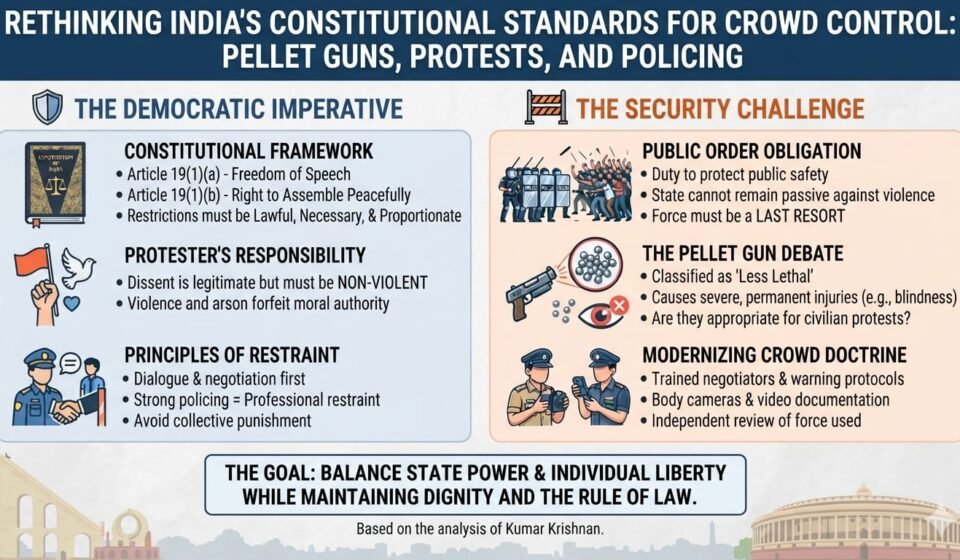
These rights are subject to reasonable restrictions in the interests of public order, but such restrictions must remain lawful, necessary and proportionate. Inconvenience or disruption alone cannot justify excessive force. Authorities must assess the nature of the threat and consider less harmful measures first.At the same time, police personnel often face violent crowds, stone‑pelting, arson and assaults. The State cannot remain passive when public safety is threatened. The demand for restraint must not be confused with a demand for inaction. The real issue is proportionality: force should be used only to the extent necessary to address a genuine threat. Dialogue, negotiation, clear warnings and controlled dispersal should precede dangerous interventions. The objective must be restoration of order with the least possible harm, not punishment of protesters.
This is why the debate over pellet guns is significant. Though described as “less lethal,” they can cause permanent injuries, including blindness. The experience of Jammu and Kashmir demonstrated the devastating consequences of pellet use. Their deployment in Delhi raises the question: are such weapons appropriate for civilian demonstrations in a constitutional democracy?Allegations, however, must be tested against evidence. Security agencies have denied using unauthorised pellets, while protesters claim otherwise. The truth must emerge through forensic examination, medical records and impartial investigation. The Supreme Court’s role is crucial: it must establish facts and examine State action against constitutional standards. Justice must rest on verifiable evidence, not rhetoric.The alleged injury to protester Sahil Lochab and the delay in registering his complaint highlight institutional concerns. If an injured citizen struggles to file an FIR in the capital, what hope exists for ordinary citizens elsewhere? A responsive criminal justice system must ensure genuine complaints are recorded promptly and investigated fairly.The incident underscores the need to modernise India’s crowd‑control doctrine. Dialogue should be the first line of intervention. Police forces require trained negotiators, clear warning protocols, evacuation routes, video recording and body cameras.
Every significant use of force should be documented and independently reviewed. Such measures protect both citizens and police personnel.This debate is part of the larger unfinished agenda of police reform. In Prakash Singh v Union of India, the Supreme Court issued directions to professionalise policing. That spirit must extend to crowd management. A democratic police force must remember that a crowd is not merely a security problem but a gathering of citizens with rights. Responses must distinguish between genuine threats and legitimate dissent. Collective punishment has no place in constitutional governance.Protesters, too, bear responsibility. The right to peaceful assembly does not extend to violence or arson. Democratic protest loses its moral force when it turns violent. The State must enforce the law, while citizens must exercise rights responsibly.
The Jantar Mantar controversy is ultimately a test of institutional maturity. Government must permit impartial investigation, police must cooperate with scrutiny, political parties must avoid prejudging, and the judiciary must ensure conclusions rest on evidence. Azad’s professional perspective and Bedi’s emphasis on restraint point to an important lesson: strong policing and democratic policing are not contradictory. A strong police force is one that exercises authority without unnecessary force.India now needs a comprehensive review of its crowd‑control standards. The emphasis should shift from dispersal at any cost to conflict prevention, dialogue, graduated response and accountability. The constitutional question is larger than one protest: it concerns the balance between State power and individual liberty. The true strength of democracy lies not in silencing dissent but in accommodating disagreement while protecting public order, dignity and the rule of law.
EoM