The Mal Paharia: An Ancient Civilization Echoing from the Rajmahal Hills
By Kumar Krishnan
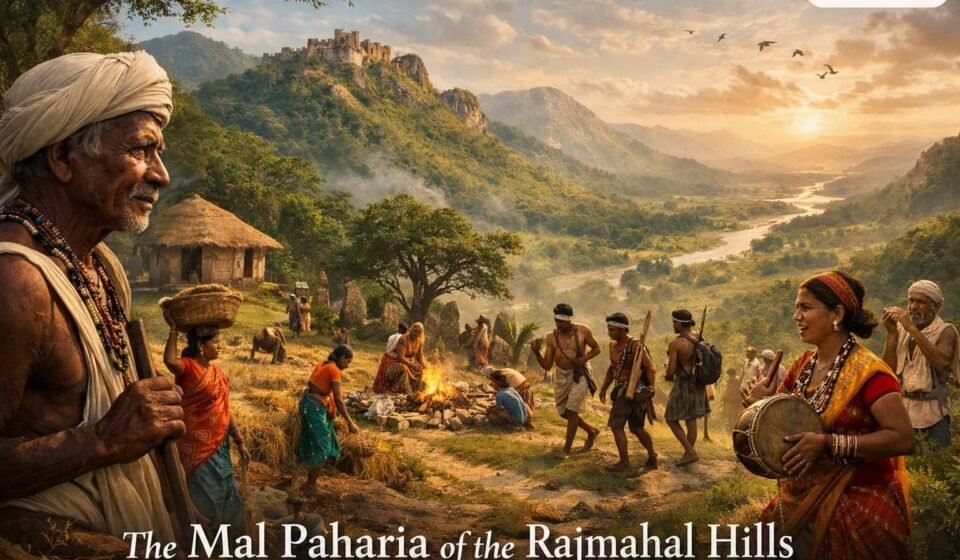
The true soul of Jharkhand resides in its indigenous communities, whose lives have remained intertwined with forests, hills and rivers for millennia. Among them, the Mal Paharia stand as one of India’s oldest and most distinctive tribal communities. Living across the Rajmahal Hills and the historic Damin-i-Koh region, they embody a civilization whose history survives not merely in written records but in oral traditions, songs, rituals and an enduring relationship with nature.
The Jharkhand Government’s Tribal Festival is therefore far more than a cultural celebration. It is an opportunity to recognise that the state’s identity has been shaped as much by its indigenous heritage as by its political history. The festival invites the wider society to appreciate communities such as the Mal Paharia, whose traditions continue to enrich India’s cultural landscape.
Recognised by the Government of India as a Particularly Vulnerable Tribal Group (PVTG), the Mal Paharia primarily inhabit the districts of Sahibganj, Pakur, Dumka and Godda, with smaller settlements extending into Bihar and West Bengal. Their cultural heartland, however, remains the Rajmahal Hills, where generations have nurtured a way of life rooted in ecological harmony.
The community speaks Malto, a language belonging to the Dravidian family. More than a means of communication, Malto preserves collective memory—folk narratives, medicinal knowledge, agricultural wisdom and spiritual traditions. Yet, like many indigenous languages, it faces the growing pressures of modern education, migration and linguistic assimilation. Preserving Malto is therefore not simply about safeguarding a language; it is about protecting an entire worldview.
The Mal Paharia social order is deeply community-oriented. Villages are traditionally led by a Manjhi, whose role extends beyond administration to the preservation of customary law and social harmony. Decisions are often reached through collective deliberation, reflecting democratic traditions that long predate modern local governance.
Their livelihood has historically centred on Kurwa, or shifting cultivation, complemented by forest produce, hunting and the sustainable use of natural resources. For the Mal Paharia, forests are not commodities but living companions, while hills and rivers are woven into their spiritual imagination. This philosophy of restrained consumption and ecological balance offers valuable lessons at a time when climate change has become one of humanity’s greatest challenges.
The cultural richness of the community is vividly expressed through its songs, dances and seasonal festivals. Music accompanies every significant moment—harvests, marriages, religious observances and communal gatherings. These oral traditions serve as living archives, transmitting history and identity across generations in the absence of written chronicles.
Yet the community continues to face profound challenges. Limited educational opportunities, inadequate healthcare, shrinking forest resources and migration have altered traditional livelihoods. Literacy levels remain below national averages, while the absence of mother-tongue education often discourages children from continuing their studies. Likewise, healthcare services remain difficult to access in the remote hill settlements.
Addressing these challenges requires more than welfare schemes. It calls for a development model that respects indigenous knowledge while expanding access to education, healthcare and sustainable livelihoods. Mother-tongue education in Malto, community-based healthcare, value addition to forest produce, organic farming, traditional crafts and youth skill development can together create a future that combines cultural continuity with economic dignity.
The Tribal Festival can play a transformative role if it becomes not merely a showcase of colourful performances but a platform for documenting indigenous knowledge, promoting Malto literature, supporting artisans and encouraging serious academic research. Universities, historians, linguists and cultural institutions must join hands in preserving this remarkable heritage.
The story of the Mal Paharia ultimately raises a larger question: Can modern development progress without erasing ancient wisdom? Their lives remind us that genuine progress is measured not only by economic growth but also by a society’s ability to protect its oldest cultures and its most vulnerable communities.
The winds that sweep across the Rajmahal Hills still carry the voice of an ancient civilization. Safeguarding that voice is not merely the responsibility of Jharkhand; it is a national obligation. In preserving the Mal Paharia, India preserves a vital part of its own civilizational memory.