
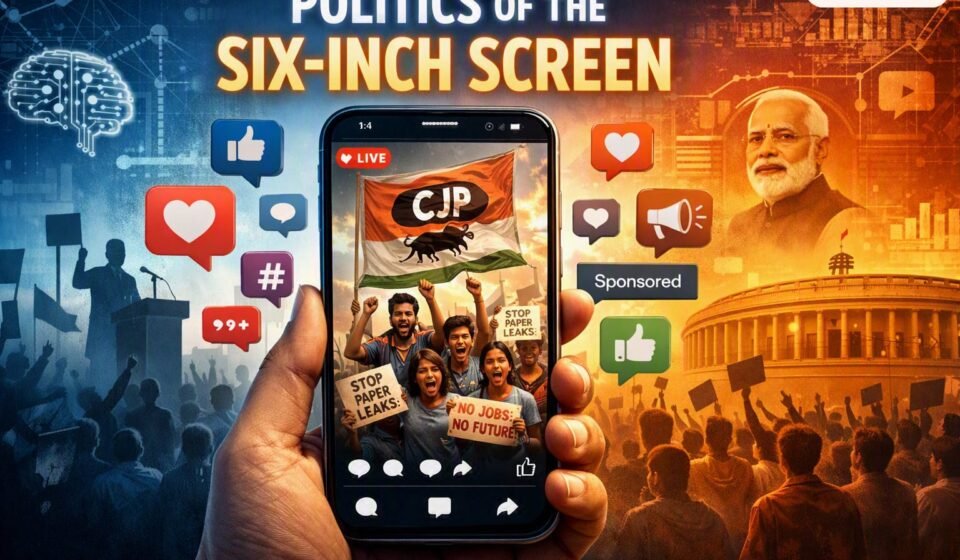
The politics of the six-inch screen
CJP’s emergence offers a glimpse into how algorithms, attention and a new generation of voters could reshape political mobilisation in India
By Amit Modi
A large number of Indians who will vote for the first time in the 2029 Lok Sabha election were born around 2010-11. Narendra Modi has been Prime Minister for virtually all of their conscious political lives. The political battles that shaped an earlier generation — Mandal, Ayodhya, coalition instability, even the elections of 2004 and 2009 — are inherited history for them, not memory.
What is native to them is the smartphone.
This matters more than it appears. Political socialisation once took place through family, newspapers, television, student organisations, public meetings and party workers. All these remain relevant, but another intermediary now sits between an event and the young citizen encountering it: the recommendation algorithm.
The emergence of the Cockroach Janta Party (CJP) is worth examining in this context. Not because there is sufficient evidence to describe it as the project of any political party — there is not — but because its rise illustrates how quickly political identity can now be constructed, distributed and converted into mobilisation.
From communication to mobilisation
CJP founder Abhijeet Dipke had worked in the Aam Aadmi Party’s communication ecosystem before going to Boston University to study Public Relations. That past association is documented; what it means for CJP today is a matter of interpretation. There is no public evidence that Dipke was sent abroad as part of a political plan, or that CJP was conceived by AAP. Such claims would require evidence that is presently unavailable.
What is relevant is Dipke’s training.
Speaking to Boston University, he described how his studies helped him understand narratives, public opinion and the use of communication to mobilise people around a cause. For somebody already familiar with political communication and social media, this was an unusually appropriate education for the politics that was about to follow.
Then came the “cockroach” controversy in May. Dipke’s response on social media turned a disparaging expression into a badge. The name was provocative enough to travel, irreverent enough for memes and sufficiently open-ended to accommodate a broader generational grievance.
That is an important feature of digital mobilisation. A conventional political organisation may take years to construct an identity. On social media, an identity can sometimes emerge in days: a phrase becomes a meme, the meme produces affiliation, and affiliation acquires a cause. CJP soon had causes that required little invention. Examination irregularities, paper leaks, unemployment and uncertainty over recruitment already occupy the anxieties of millions of young Indians. The more interesting question is how some of these anxieties acquire national visibility while others remain local.
When reach becomes power
Consider Delhi and Ranchi. The student mobilisation associated with CJP at Jantar Mantar acquired substantial visibility on Instagram. Ranchi, meanwhile, has witnessed student protests around JSSC-CGL and recruitment-related grievances. The two protests are not identical, and crude comparisons of view counts can mislead. Delhi has a larger national media ecosystem; the audiences, accounts and networks involved may be different.
Yet Ranchi poses an uncomfortable question. If examinations, recruitment and insecurity about the future constitute a national youth concern, why does one agitation enter millions of feeds while another, involving young Indians with recognisably similar anxieties, remain far less visible nationally? There may be entirely ordinary explanations. The Delhi content may have been better produced. It may have generated greater engagement. More influential accounts may have shared it. Its audience may have been geographically broader.
But this is precisely the point: public visibility is no longer a reliable proxy for the physical size or seriousness of a public grievance.
Between the protest and the citizen now stands a distribution system whose choices most citizens cannot inspect. Instagram does not simply display everything uploaded to it. Recommendation systems estimate what a user is likely to watch, share or engage with and distribute content accordingly. Consequently, an agitation involving fewer people can appear ubiquitous while a substantial protest elsewhere remains largely invisible outside its region.
The political significance of this asymmetry is considerable.
The unanswered question of paid reach
Recent scrutiny of Meta adds another layer. In August, Meta apologised to the Indian government after a video involving Prime Minister Modi was erroneously restricted. Reports citing government sources also referred to the company acknowledging payments for the promotion of certain categories of content.
That acknowledgement cannot legitimately be converted into a claim that CJP purchased reach, much less that a political party financed it. No publicly established evidence presently supports either proposition. It does, however, sharpen a question that will become increasingly important in electoral democracies: when apparently political or movement-related content reaches millions, how much of that reach was earned, recommended or purchased?
These are three different things, but to the citizen scrolling through a feed they can look remarkably similar. A sponsored campaign is at least identifiable as advertising. Algorithmic amplification is more complicated. The user generally does not know why a particular protest, grievance or political personality has appeared repeatedly in the feed, or why another has not.
The result is a new form of political power: the power to determine salience.
Politics after the party worker
There is a temptation to view every viral political movement through the familiar vocabulary of conspiracy, funding and party control. That may obscure the more consequential transformation. A movement need not be secretly controlled by a political party to alter electoral politics. Nor does every participant need to share an ideology.
It may be enough to assemble genuine grievances, give them a recognisable vocabulary and make them travel. One week the subject could be examination leaks; another, unemployment; then school quality, recruitment or institutional accountability. Each grievance may be authentic. Yet, taken together and amplified efficiently, they can force governments into a permanently reactive posture.
Borrowing cautiously from cybersecurity, one might call this a form of political DDoS (DDoS, Distributed Denial of Service, is a cyberattack in which a system is flooded with requests from multiple sources at once, overwhelming its capacity and disrupting normal functioning.) — not an attack in the technical sense, but a communication environment in which multiple streams of public dissatisfaction simultaneously compete for the State’s attention. The strategic advantage lies not necessarily in inventing falsehoods. It can lie in something subtler: deciding which truth is foregrounded, at what moment, and before which audience.
That is the politics of attention.
CJP may ultimately prove to be nothing more, or less, than an independent youth movement that found the right language at the right moment. The available evidence does not justify a stronger conclusion. But its emergence points towards a larger question for 2029. A generation is approaching the ballot box whose political world has been substantially mediated by personalised feeds. Political actors will compete not merely for its vote but for the far scarcer commodity that precedes it — its attention.
The next general election will still be fought in constituencies, rallies and polling booths. But one of its most important battlegrounds may already be open.
It is the six-inch screen in the voter’s hand.
(The views expressed are personal. The article examines an emerging political phenomenon on the basis of publicly available information and does not allege wrongdoing by any individual or organisation.)
Amit Modi is an entrepreneur, digital marketing professional, podcaster, and media creator based in Jharkhand. He is the Founder & CEO of DigiCrow Consulting, a digital marketing and communications company, and the Founder & Host of KankeTalks, a podcast featuring conversations with policymakers, bureaucrats, entrepreneurs, social leaders, and changemakers.