
Tusker Menace: Drone surveillance launched as SAIL workers escape close encounter
Pioneer News Service
Jamshedpur
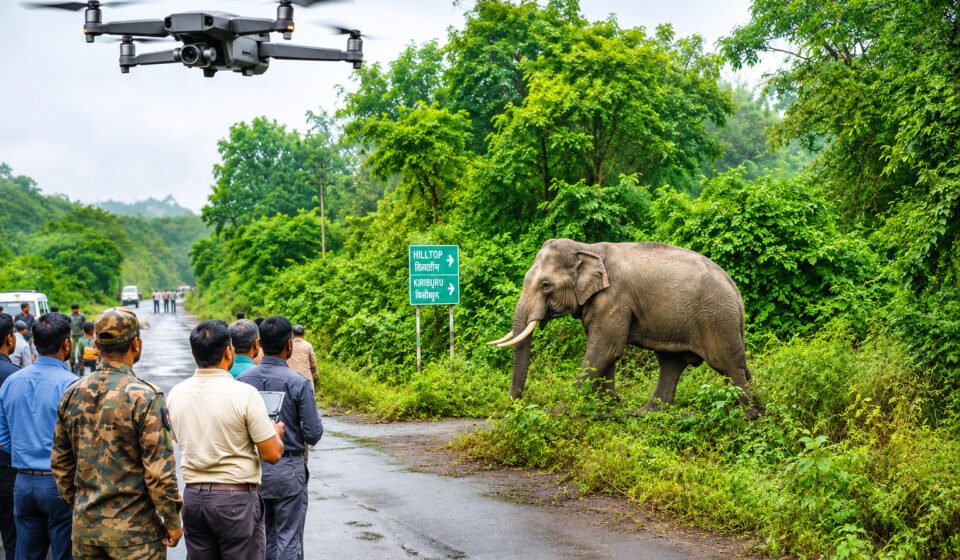
A wild elephant’s intrusion into the Kiriburu township of West Singhbhum district triggered panic among residents and employees of the Steel Authority of India Limited (SAIL), prompting the Forest Department to deploy drone surveillance to track the animal’s movement and prevent any untoward incident. The tusker, which entered the mining township late on Monday night, is currently believed to be taking shelter in dense vegetation near the old Magazine House along the busy Kiriburu-Hilltop main road, leaving commuters and local residents on edge.
The dramatic incident unfolded around 11 pm on Monday when the elephant suddenly crossed the main road and entered the Meghahatuburu iron ore mine operated by SAIL. According to eyewitnesses, the tusker wandered into the mechanical shovel section of the mine while night-shift operations were underway. The unexpected appearance of the wild animal created panic among workers, who immediately abandoned their workstations and rushed to take shelter behind heavy earth-moving equipment, vehicles and nearby buildings.
Mine employees said the elephant remained inside the mining premises for several minutes, moving around the machinery before quietly retreating into the adjoining forest. Fortunately, no injuries or damage to equipment were reported, although the incident caused considerable anxiety among workers, many of whom described it as one of the closest encounters they had experienced with a wild elephant inside the mining complex.
Fresh concern emerged early Tuesday morning when local residents again spotted the elephant near the old Magazine House on the Kiriburu-Hilltop Road at around 5.30 am. The sighting was immediately reported to the Forest Department, which rushed personnel to the area and launched an intensive monitoring operation.
Forest Department official Shankar Pandey said the department had deployed a drone operator to monitor the elephant from the air. The aerial surveillance is aimed at identifying the animal’s exact location and movement without disturbing it, enabling forest personnel to plan a safe strategy to guide the tusker back into the core forest area. Officials said drone monitoring would also help reduce the risk of direct confrontation between the elephant and the public.
The Forest Department has issued an advisory asking residents, commuters and SAIL employees to remain vigilant and avoid venturing close to the elephant. Authorities have specifically warned people against attempting to take selfies, throw stones or otherwise provoke the animal, cautioning that such actions could trigger an aggressive response and lead to serious injuries or loss of life.
The latest incident has once again drawn attention to the growing challenge of human-elephant conflict in the Saranda forest region. Wildlife experts say sightings of elephants in industrial townships and residential areas have become increasingly frequent in recent years. They attribute the trend to shrinking natural habitats, expanding mining and human activities around forest areas, and the declining availability of food and water inside the forests. Forest officials have appealed to residents to cooperate with the ongoing operation until the elephant is safely guided back into its natural habitat.