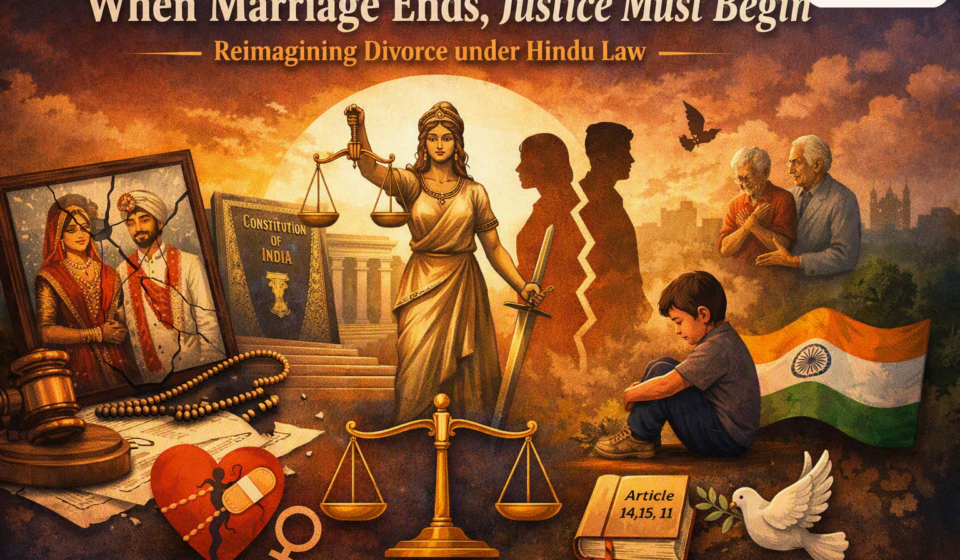
When Marriage Ends, Justice Must Begin: Reimagining Divorce under Hindu Law
By Richa Sanchita
Marriage has traditionally occupied a sacred place in Hindu society, symbolising companionship, mutual trust and shared responsibilities. Yet, not every marriage survives the realities of modern life. Domestic violence, emotional abuse, prolonged incompatibility and irretrievable breakdown have compelled Indian courts to rethink whether the law should merely preserve marriages or protect the dignity of those trapped within them. Increasingly, the answer has emerged not from social customs but from the Constitution of India.
Although divorce is governed by the Hindu Marriage Act, 1955, its interpretation today is deeply influenced by Articles 14, 15 and 21 of the Constitution. Equality before law, protection against discrimination and the right to live with dignity have transformed matrimonial jurisprudence from a rigid statutory framework into one rooted in constitutional values.
The Hindu Marriage Act recognises divorce on grounds including cruelty, adultery, desertion, conversion, mental disorder and mutual consent. However, it is the judiciary that has expanded these provisions to meet contemporary realities.
Perhaps the most remarkable judicial development has been the evolution of the concept of mental cruelty. In V. Bhagat v. D. Bhagat (1994), the Supreme Court held that cruelty is not confined to physical violence. Conduct that causes deep mental pain, frustration or suffering, making it impossible for spouses to live together, may itself justify divorce. This decision fundamentally altered matrimonial jurisprudence by acknowledging the invisible scars of emotional abuse.
The Court elaborated this principle in Samar Ghosh v. Jaya Ghosh (2007), where it declined to prescribe an exhaustive definition of mental cruelty. Instead, it laid down broad illustrative principles, recognising that persistent humiliation, denial of companionship, false accusations, indifference and sustained emotional neglect may each amount to cruelty depending upon the circumstances. The judgment reflected judicial sensitivity to changing social relationships and the psychological dimensions of marriage.
Similarly, in K. Srinivas Rao v. D.A. Deepa (2013), the Supreme Court observed that filing false criminal complaints and making reckless allegations against a spouse and his family could constitute mental cruelty. The Court cautioned that matrimonial litigation should not become an instrument of vengeance. Justice, it observed, demands fairness even amid marital discord.
The Court adopted a similar approach in Narendra v. K. Meena (2016), where persistent insistence by one spouse that the other sever ties with aged parents was treated, in the facts of the case, as conduct amounting to cruelty. The judgment recognised that Indian family relationships often extend beyond the husband and wife, and unreasonable interference with such relationships may destroy the very foundation of matrimonial harmony.
One of the most debated questions in Indian family law concerns the doctrine of irretrievable breakdown of marriage. Parliament has yet to incorporate it as a statutory ground for divorce despite repeated recommendations by the Law Commission. Nevertheless, judicial thinking has steadily evolved.
In Naveen Kohli v. Neelu Kohli (2006), the Supreme Court lamented that compelling parties to remain tied to a marriage that had completely collapsed served neither the institution of marriage nor the interests of justice. The Court urged Parliament to recognise irretrievable breakdown as an independent ground for divorce, observing that prolonged litigation often deepens bitterness rather than preserving relationships.
The constitutional significance of this debate reached its culmination in Shilpa Sailesh v. Varun Sreenivasan (2023). A Constitution Bench held that the Supreme Court, while exercising its extraordinary powers under Article 142, may dissolve a marriage that has irretrievably broken down to do “complete justice” between the parties. Although this power remains exceptional, the judgment demonstrates the Court’s willingness to ensure that law remains responsive to human realities.
Modern matrimonial jurisprudence also draws strength from decisions concerning personal autonomy. In Shafin Jahan v. Asokan K.M. (2018), popularly known as the Hadiya case, the Supreme Court reaffirmed that the freedom to choose one’s spouse is an intrinsic part of personal liberty under Article 21. Marriage, the Court held, is a matter of individual choice, free from societal or parental control. Likewise, in Shakti Vahini v. Union of India (2018), while addressing honour crimes, the Court declared that constitutional morality must prevail over social morality. These principles extend beyond the formation of marriage and inform its dissolution as well: the dignity and autonomy of individuals cannot be subordinated to societal expectations.
The Constitution Bench judgment in Joseph Shine v. Union of India (2018), which struck down the offence of adultery, further reinforced this constitutional vision. The Court observed that marriage does not extinguish individual dignity or equality. A spouse is not the property of another, and constitutional rights continue within marriage. This reasoning has profoundly influenced the interpretation of matrimonial disputes, shifting the focus from control to mutual respect.
Despite this progressive jurisprudence, challenges remain. Matrimonial disputes continue to languish in courts for years. Delayed justice often aggravates emotional trauma, increases litigation costs and adversely affects children. Family courts require greater institutional support, trained counsellors, effective mediation mechanisms and time-bound procedures to fulfil their constitutional role.
Marriage is an important social institution, but it cannot be preserved by sacrificing liberty, equality or dignity. The Constitution does not encourage the breakdown of families; it ensures that when families do break down, the law responds with fairness, compassion and justice.
As India moves towards a more rights-based understanding of family law, one principle has become unmistakably clear: marriage may begin with tradition, but when it ends, justice must begin with the Constitution.
Next Week: Part II – Maintenance Is Not Charity: Economic Justice after Divorce.
Richa Sanchita is an advocate of Jharkhand High Court