Down Memory Lane : IV
By Gautam Sarkar
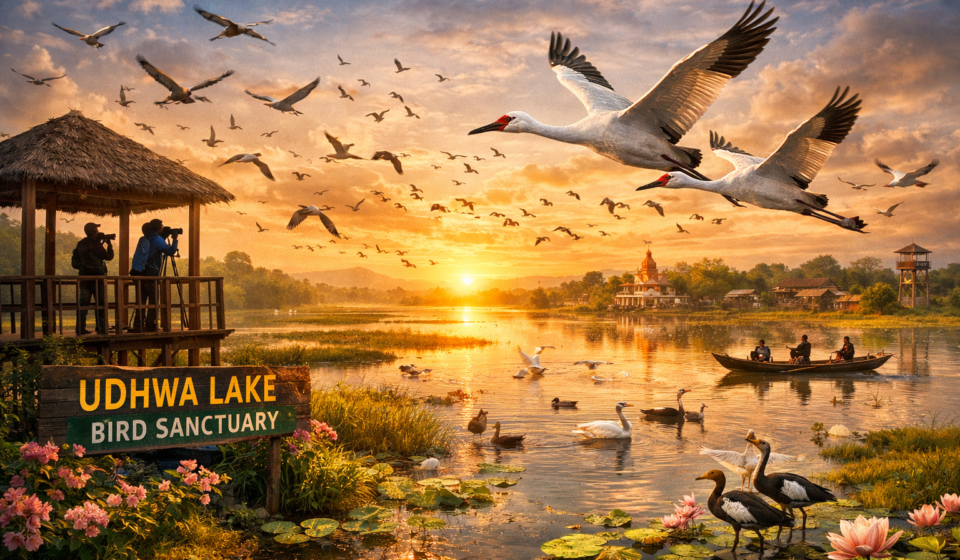
The old history of Udhwa Lake Bird Sanctuary, as seen through my eyes, is highly fascinating; back then Jharkhand had not yet been become a separate state.
The sanctuary was designated as a Ramsar Site in 2025, recognizing it as a wetland of international importance for its critical ecosystems, support water resources, and provide vital habitats for diverse flora, fauna, and thousands of migratory birds.
But in early 1990s, the Rajmahal subdivision of Sahebganj district in the then undivided Bihar was notorious as a paradise for bird hunters. During the winter season in particular, the area was famous for its abundance of migratory birds and for the thriving market that sold their meat. Near the neighbouring village of Radhanagar, the Futani Bazaar was one of the largest trading centers for migratory birds.
In late 1980s, I visited the region’s vast wetland, spread over approximately 5.65 square kilometers, which comprised two enormous interconnected lakes – Pataura and Berhale. I was with former MLA of the Rajmahal Assembly constituency,, Nathmal Dokania, who explained to me how the wetland was connected to the Ganga river at Farakka through the historic Udhwa Nala, forming a unique and ecologically significant aquatic system.
On a cloudy morning in December, I set out for Rajmahal with Arvind Mishra of the Mandar Nature Club (MNC), a Bhagalpur based body working for the causes of environmental conservation. (Mishra is currently an esteemed member of the Governing Council of the Bombay Natural History Society (BNHS).)
Accompanying us were several birdwatchers, environmental enthusiasts, college teachers and a group of students from St. Joseph’s School, Bhagalpur. In the freezing cold and rain, we got soaked while exploring the whole area and watching birds.
By that time, the government had officially declared the two lakes together as the Udhwa Lake Bird Sanctuary, and the necessary notification had already been issued. But the sanctuary remained under constant pressure from poachers, fishermen using small boats to catch fish within the lakes, and the construction of illegal settlements by Bangladeshi infiltrators in the surrounding areas. Collectively, these activities posed a continuous and grave threat to the very existence of the Udhwa Bird Sanctuary.
My second visit to that place was truly horrifying. In one of the families of illegal encroachers living within the notified boundaries of the sanctuary, a prospective groom’s family had come to see a bride. As part of the hospitality extended to the guests, they were served the meat of the ‘Lalsar’, critically endangered Siberian Crane, a migratory bird protected under international conservation efforts. I along with some local volunteers there approached the police station, but police remained inactive.
After my report was published, the government’s negligence in protecting the sanctuary sparked widespread outrage across the country. The public awareness movement led by MNC gathered even greater momentum, intensifying the demand for stronger conservation measures. Mishra and his associates continued to organize regular conservation camps while simultaneously leading various movements through different platforms to press the government to take effective measures for protecting the sanctuary.
In a neglected rural wetland like Udhwa, more than 80 species of migratory birds arrived year after year from Siberia, Central Asia, and various parts of Europe, seeking refuge from the severe winter in their native lands, just as they did in many other parts of India. Tragically, however, most of these foreign visitors never managed to return home, falling victim to the people of the Udhwa region.
Changes began due to the efforts of the MNC. Widespread bird hunting was stopped and the chirping of birds could be heard during winter.
To witness, during my career as a journalist, how the Udhwa I once knew was reshaped through the tireless work of the MNC remains one of the most rewarding and satisfying experiences of my professional life.
( to be concluded…… )