
CM Hemant Soren unveils Jharkhand’s Vision 2050 in Delhi
Jharkhand must be known for its ‘minds, not just mines’, says CM
Global tech leaders and policymakers join discussions on AI, digital governance and investment-friendly reforms
PNS
NEW DELHI/RANCHI
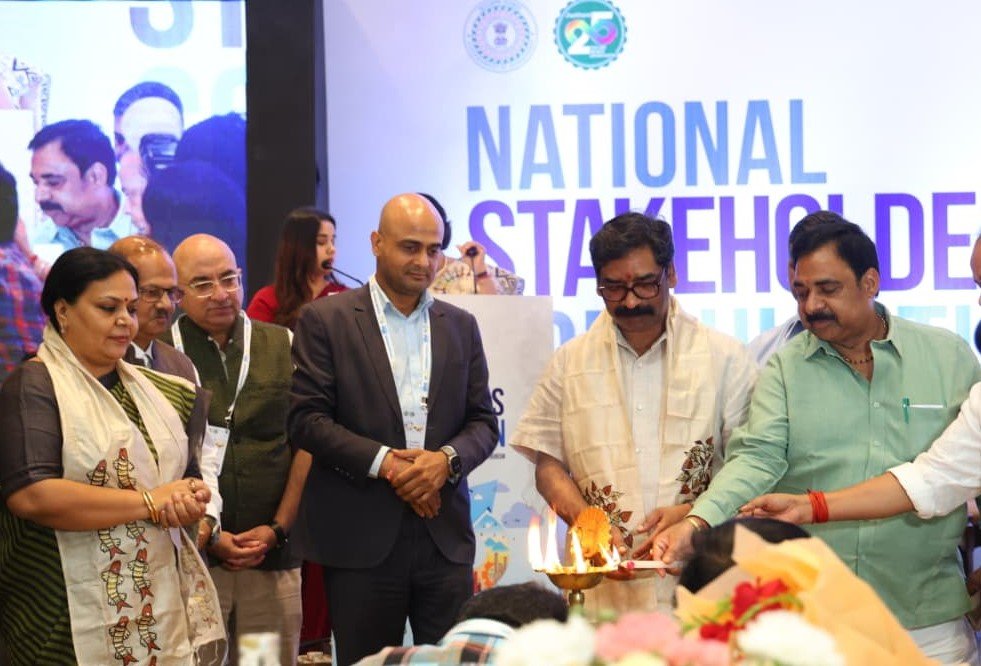
Chief Minister Hemant Soren along with his Cabinet colleagues lights the ceremonial lamp to inaugurate the two-day National Stakeholders’ Consultation in Delhi on Wednesday.
Seeking to reposition Jharkhand from a mineral-rich state to a knowledge-driven economy, Chief Minister Hemant Soren on Wednesday launched a two-day National Stakeholders’ Consultation on the state’s Vision 2050, calling for a development model anchored in artificial intelligence (AI), digital governance, research and innovation.
Addressing policymakers, industry leaders, global technology companies, academicians and domain experts at the inaugural session, Soren said Jharkhand’s future identity must extend beyond its abundant natural resources and embrace intellectual capital, innovation and technology-led growth.
“Jharkhand should be recognised not only for its mines but also for its minds,” the Chief Minister said, outlining an ambitious roadmap to transform the state into a competitive destination for technology, investment and knowledge-based industries. “Our identity should be built not merely on resources but on research, not just extraction but innovation, and not only growth but inclusive and extensive growth.”
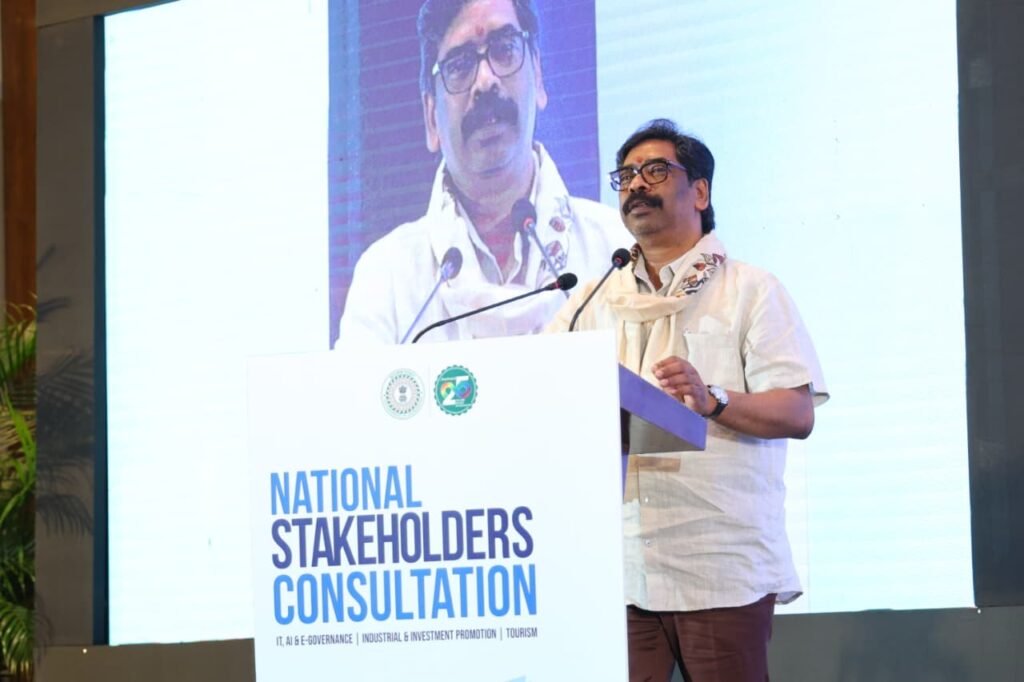
Chief Minister Hemant Soren addresses industry leaders and delegates during two-day National Stakeholders’ Consultation in Delhi on Wednesday.
The consultation, jointly organised by the state government’s Information Technology, Industries and Tourism departments in New Delhi, brought together representatives from leading technology companies including Microsoft, Google and IBM, along with industry associations, investors and policy experts to deliberate on strategies for accelerating Jharkhand’s economic transformation.
Soren stressed that while Jharkhand has historically powered India’s industrial growth through its vast mineral wealth, the next phase of development must focus equally on research, innovation and human capital. He said the state government was committed to aligning Jharkhand with emerging technologies and preparing it for the demands of the future digital economy.
“The country’s industrial progress cannot be complete without Jharkhand’s development. Along with our natural resources, we must give equal importance to research, innovation and a knowledge-based economy. Our objective is not merely economic growth but inclusive, sustainable and broad-based development,” he said.
A major highlight of the inaugural session was the presentation of concept papers for several key policy initiatives aimed at strengthening Jharkhand’s investment climate. These included the proposed Jharkhand AI Policy, Jharkhand Investment Promotion Policy, Jharkhand Tourism Policy, Jharkhand Textile Policy, revised Jharkhand Industrial Area Development Authority (JIADA) regulations and a new Public-Private Partnership (PPP) policy framework.
The draft policy documents were shared with industry stakeholders to invite suggestions before their finalisation, with the government seeking to make them more investor-friendly while ensuring employment generation and balanced regional development.
Officials said the consultations form part of a broader effort to prepare long-term policy frameworks that can attract investments in emerging sectors such as artificial intelligence, information technology, advanced manufacturing and digital public infrastructure.
Representatives from Microsoft, Google and IBM made detailed presentations highlighting opportunities for expanding Jharkhand’s digital ecosystem, strengthening technology infrastructure, building AI capabilities and creating an enabling environment for private investment.
Senior executives also shared recommendations on enhancing digital governance, improving ease of doing business, developing skilled manpower and creating technology-led employment opportunities.
A dedicated Business-to-Government (B2G) interaction was held during the day, enabling industry leaders to engage directly with the state government on investment opportunities, regulatory reforms and collaborative initiatives in information technology, AI and other emerging technology sectors.
Soren said the government would incorporate feedback received during the consultation while finalising the state’s policy architecture.
“The suggestions received from stakeholders will help us formulate policies that not only attract investment but also accelerate employment generation and ensure inclusive development,” he said, adding that continuous engagement with industry and experts would play a crucial role in shaping Jharkhand’s long-term development trajectory.
Chief Secretary Avinash Kumar, while outlining the objectives of the consultation, emphasised the growing importance of technology-driven governance and innovation in accelerating socio-economic development. He said the state was committed to leveraging digital technologies across sectors to improve public service delivery and enhance competitiveness.
The event was attended by Rural Development and Panchayati Raj Minister Deepika Pandey Singh, Health Minister Irfan Ansari, Industries, Labour and Employment Minister Sanjay Kumar Yadav, Tourism, Art, Culture, Sports and Youth Affairs Minister Sudivya Kumar, Development Commissioner Ajay Kumar Singh and senior officials from various departments.
Among the technology leaders participating in the discussions were Talleen Kumar of IBM, Sandeep Arora of Microsoft and Rajesh Ranjan of Google, who outlined global technology trends and their relevance to Jharkhand’s development ambitions.
The two-day consultation is expected to culminate in a set of policy recommendations that will shape Jharkhand’s Vision 2050 roadmap, with the government aiming to position the state as a major destination for digital innovation, technology investment and sustainable industrial growth. The initiative also reflects the state’s effort to diversify its economy beyond mining by fostering research, entrepreneurship, digital infrastructure and future-ready industries.