When the Question “Am I Enlightened?” Becomes the Wrong Question
By Antara Mohan
Some essays give you information. A few leave you with a question that stays with you after you have finished reading.
Dibyadip Mitra’s essay, written when he was seventeen, did that to me. His essay was selected among the top 17% of more than 100,000 submissions to the John Locke Institute Essay Competition. But what stayed with me was not the number. It was the question at its centre: If you achieve enlightenment, how will you know?
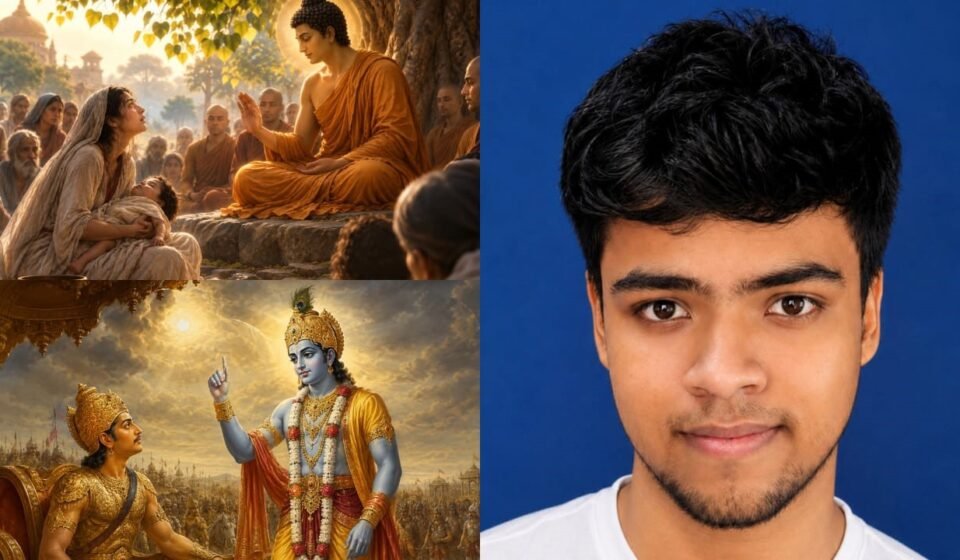
Dibya begins with Kisa Gotami from Sermon at Benares. A grieving mother searches for a medicine to bring her dead child back. The Buddha sends her from house to house, asking for mustard seeds from a family that has never known death. She finds none. Slowly, she encounters a truth that cannot be confined to her own grief.
Dibya sees something important in this. Kisa Gotami does not simply decide that she has understood. She is brought to understanding through repeated encounters with reality. This becomes the first clue in his wider argument: perhaps spiritual understanding is not certified by what we feel inside, but by what remains true when we repeatedly confront life.
The essay then becomes more uncomfortable. Peace, compassion, fearlessness and freedom from desire are often presented as signs of enlightenment. But are they proof? Human beings can feel extraordinary certainty in grief, love, joy or other powerful emotional states. A feeling may be completely genuine while the conclusion drawn from it is still mistaken.
Then comes the question I found hardest to shake off: if enlightenment changes the self itself, who recognises that change?
Dibya brings Buddhism, Sāṃkhya and the Bhagavad Gita into conversation, while carefully recognising that they do not describe the self or liberation in the same way. Yet each raises a challenge to the ordinary idea of “I have achieved enlightenment, therefore I know that I have.” If the very self being transformed is also the one trying to certify that transformation, self-certainty becomes difficult.
That made me think about a strange danger in spiritual life. We may begin by seeking freedom from ego and eventually become attached to the identity of being “spiritually advanced”.
What I found most convincing was the essay’s shift from extraordinary experiences to ordinary life. What remains after the experience is over? Does compassion survive disappointment? Does craving lose its grip? Does the need for recognition become weaker? Does the transformation endure when meditation ends and life becomes difficult?
The essay does not dismiss enlightenment as unreal. Nor does it accept every claim of spiritual certainty. Instead, it asks us to distinguish a powerful experience from a lasting transformation.
And perhaps that is where the essay leaves its most interesting question.
Maybe the real question is not, “How do I know that I am enlightened?”
Maybe it is:
If I still need to ask whether I am enlightened, what does that say about the “I” asking?
That question stayed with me.