Can Algorithms Fragment Democracy? The Gen Z Protests Suggest Otherwise
By Sayanee Mandal
Over the past couple of years, much of my writing and research has revolved around a simple yet
unsettling question: What happens to democracy when algorithms begin to shape political
consciousness?
Artificial intelligence-powered recommendation systems are designed to maximise engagement. They
learn our preferences, anticipate our reactions and feed us content most likely to keep us scrolling.
Beyond personalising our feeds, they can subtly personalise our perception of reality. By continually
serving us content that aligns with our existing preferences and beliefs, they create the illusion that
our worldview is both widely shared and rarely challenged. When dissenting voices are filtered out
and familiar narratives repeated endlessly, the line between public opinion and algorithmic curation
begins to blur.
That is what makes the Gen Z protest organised by the Cockroach Janta Party feel so special.
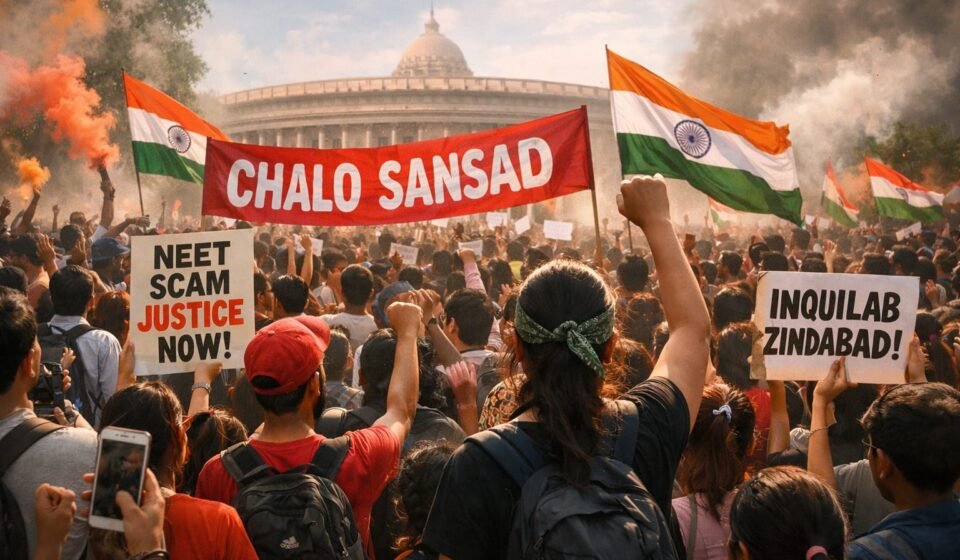
As thousands of students converged at Jantar Mantar before marching towards Parliament, they
carried with them grievances that had been simmering for a long time — demands for accountability
over the NEET paper leak and a growing frustration with what many saw as the erosion of educational
justice. Many travelled across cities, despite metro station closures, internet shutdowns and
widespread uncertainty; the youth showed up. In that moment, politics escaped the confines of the
screen and returned to the streets. Chants of “Inquilab Zindabad” (Long Live the Revolution) rolled
through the crowd, not as trending audios or viral clips, but as voices carried from one person to
another. The march transformed private frustration into a public reality. What participants experienced
went beyond a protest and towards a collective recognition of reassuring knowledge that their
concerns were not isolated concerns but a collective sentiment shared by thousands standing beside
them.
When every individual consumes a different political reality online, collective action becomes
increasingly difficult. Polarisation intensifies, and dialogue gives way to ideological silos.
Yet what unfolded during the Sansad March on 20 July 2026 challenged this hypothesis. I had begun
to believe that in a country where dissent is increasingly dismissed, and digital feeds and mainstream
media often distract us from pressing realities, it was becoming progressively harder for citizens to
challenge authority and meaningfully defend democracy.
Yet thousands of young people stepped away from personalised feeds and into a shared public space.
What had existed as isolated frustration across countless individual screens transformed into a
collective expression of hope, dissent and democratic participation. For a generation frequently
described as politically apathetic, the march revealed something remarkably different. Beneath the
layers of algorithmic curation, people still cared enough to show up.
The beauty of the protest was not simply in its scale, but in its humanity.
Students from different universities, cities and social backgrounds marched shoulder to shoulder,
united by a shared purpose. In the sweltering July heat, volunteers moved through the crowds
distributing water and food, while legal and medical aid camps stood ready to assist anyone in need.
Gurudwaras opened their doors, offering shelter, meals and a place to rest for weary protesters. It was
a quiet yet powerful display of solidarity, strangers caring for strangers, bound not by identity but by a
common conviction. For perhaps the first time in a long while, the protest made the ideal of unity in
diversity feel tangible rather than aspirational. Thousands of voices rose together with the
unmistakable reassurance that despite our differences, India could still come together in pursuit of a
shared democratic ideal.
This is not to suggest that technology has ceased to shape political behaviour. Even as the march
unfolded, the digital world told a very different story. My own feed became flooded with diverging
opinions. Many celebrated the movement as a powerful expression of democratic participation, while
others dismissed it outright by mocking the movement and spreading content manufactured to smear
it. Recommendation systems continued to do what they are designed to do, serving each user content
that affirmed their existing ideological leanings. For many, the protest became yet another event
filtered through carefully curated narratives, strengthening beliefs they already held rather than
inviting them to engage with opposing perspectives.
In that sense, my original hypothesis still holds. What the Chalo Sansad March and the Cockroach
Janta Party protest demonstrated, however, was that these digital silos are not insurmountable. Despite
the polarisation that unfolded online, thousands of young people chose to step beyond their screens
and occupy a shared public space. The algorithms continued to curate reality, but they could not
manufacture or extinguish the courage, conviction and solidarity of those who showed up.
Whether the demands of the march ultimately lead to political change remains uncertain.
Governments may respond, delay or refuse, and history may eventually judge the movement by its
outcomes.
Yet for those who were there, what will linger far longer than any official response is the
memory of thousands of strangers walking shoulder to shoulder, united by the belief that their voices
still mattered. In that shared act of dissent, democracy did not merely survive; it breathed again.
Sayanee is a Writer, Researcher, Media and Culture Analyst, and Creative Project & Marketing Strategist, with academic grounding from JNU and the University of Glasgow.